
Riding Romania

Romania essentials
- Languages
- Romanian; English among younger people
- Currency
- Romanian leu (RON)1 USD ≈ 4.88 RON on 24 Nov 2026
- Time zone
- UTC+2, UTC+3 in summer
- Plugs and power
- 230 V, 50 Hz
Type C Type F - Emergency numbers
- All emergencies 112
- Tipping
- Restaurants
- About 10%
- Hotels
- A few lei for porters and housekeeping
- Tours and guides
- Around 10%
Most riders come for the Transfăgărășan and the Transalpina, the two high roads over the Southern Carpathians, and base themselves in Sibiu, under an hour from the foot of each. Brașov is the other base, for Bran and the Saxon villages with their fortified churches. The quiet alternatives are the Apuseni Mountains west of Cluj-Napoca and the Danube gorge road south of Timișoara.
Ride Concierge
Your ride in Romania, arranged.
Tell us what you want. We find the bike or tour, write to the operator and come back with a confirmed booking.
- You describe the rideBike, dates, budget. A sentence is enough.
- We ask the operatorAnd bring their quote back to you.
- You approve, we confirmYou pay the operator directly.
Free to ask. Our 5% fee is due only after a confirmed booking.
See how it works- When to ride
- June to September; the high passes open in late May or June and close in October
- Traffic
- Drives on the right; motorcycles ride with dipped lights always
- Licence
- Motorcycle licence; EU and UK licences accepted, others need an IDP
- Alcohol
- Zero limit: no alcohol at all
- Day rate
- $21–$181
- In the catalog
- 116 bikes and tours, 14 operators
Where to ride
Each letter matches the map.

Illustration Transfăgărășan (DN7C)
The road most riders come to Romania for. Built in 1970 to 1974 as a military route, DN7C crosses the Făgăraș Mountains between Transylvania and Wallachia. From the north it leaves DN1 at Cârțișoara and climbs 13 km of hairpins up a glacial cirque to Bâlea Lake, then goes under the ridge through an 884 m tunnel at 2,042 m. The south side drops past the Capra falls, runs about 20 km along Lake Vidraru, crosses the 166 m dam and passes below Poienari Castle to Curtea de Argeș. Average speeds are around 40 km/h. The high section is closed from about late October to June and, when open, only from 07:00 to 21:00.

Illustration Transalpina (DN67C)
The highest road in Romania, topping out at 2,145 m at the Urdele Pass. DN67C runs south from Sebeș up the Sebeș valley past Lake Oașa to Obârșia Lotrului, then runs along a ridge for about 20 km before dropping through the ski resort of Rânca to Novaci. It was an old shepherds' path, rebuilt as a royal road in the 1930s and again as a modern road from 2008. The speed limit on the high section is 30 km/h. Allow at least three hours end to end. It is closed in winter, and in the summers of 2025 and 2026 its high section was also closed at night. From Sibiu, Sebeș is 53 km west, and the Lotru valley (DN7A) gives a way back east to make a loop.
Start from Sibiu

Illustration Saxon villages and fortified churches
The rolling country between Brașov and Sibiu, settled by German-speaking Saxons from the 12th century, who walled their churches against raids. Ride north from Brașov to Rupea and the village of Viscri, whose fortified church was first built around 1100, on to Sighișoara, a walled hill town on the UNESCO list, then west to Biertan, seat of the Lutheran bishops from 1572 to 1867, and on to Sibiu. The main roads are paved and busy; the roads into the villages are narrower, slower and shared with horse-drawn carts. Two days lets you stop properly.

Illustration Bran Pass and the Rucăr road (DN73)
DN73 runs 133 km from Brașov to Pitești. It passes Râșnov and its hilltop citadel, then Bran Castle, built by Saxons in 1377 on the old border with Wallachia, then climbs over the hills to Rucăr and down to Câmpulung. It is a short mountain ride from Brașov, and the usual way to link Brașov with the south end of the Transfăgărășan at Pitești.
Start from Brașov

Illustration Apuseni Mountains (DN75)
West of Cluj-Napoca. Ride south to Turda and its gorge, then DN75 west up the Arieș valley through Câmpeni and Albac to Arieșeni, and over the Vârtop Pass (1,160 m) to Ștei. Side trips go to Rimetea, a village under the 1,128 m crag of Piatra Secuiului, and to the Scărișoara ice cave at about 1,150 m above Gârda de Sus. Much of the range is a natural park of karst, caves and forest. It is quieter than the Făgăraș roads, and you need more time for it than the distance suggests.
Start from Cluj-Napoca

Illustration Danube gorges (DN57)
DN57 follows the Romanian bank of the Danube through the Iron Gates, with Serbia across the water. Ride south from Timișoara to Oravița and Moldova Nouă, then east along the river past the Kazan gorges, where the Danube narrows to about 150 m, and the 55 m rock carving of the Dacian king Decebalus near Dubova, to Orșova. Turn north through the spa town of Băile Herculane and back via Caransebeș. Moldova Nouă to Orșova is about 104 km of river road.
Start from Timișoara
Regions of Romania
Where riders base themselves

Sibiu
Base for both high roads: 49 km to the foot of the Transfăgărășan at Cârțișoara and 53 km to Sebeș at the north end of the Transalpina.
2 bikes, 19 tours

Brașov
Base for Bran, Râșnov and the Saxon villages, with the Prahova valley to the south and the Transfăgărășan 105 km west.
5 bikes
Bucharest
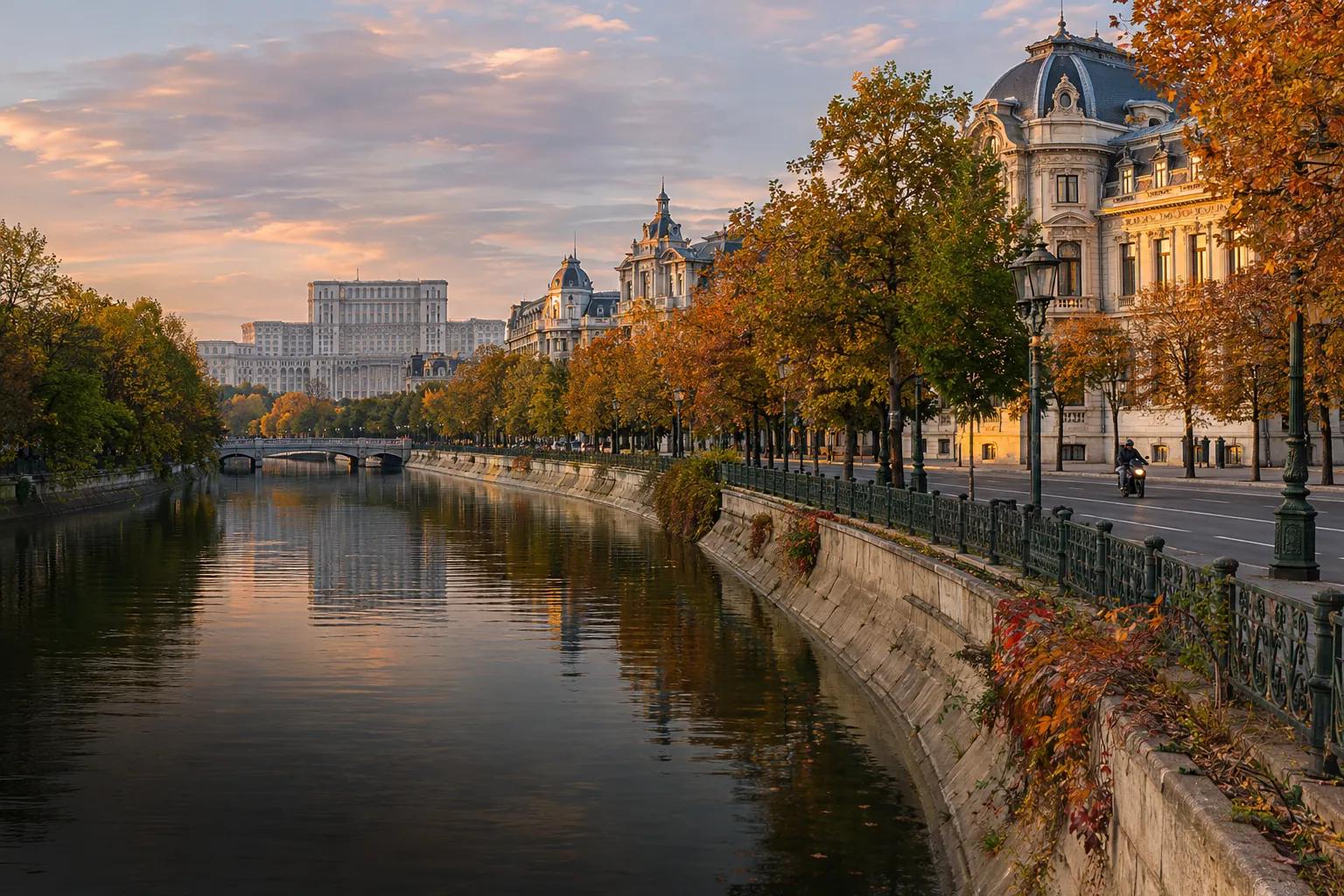
Where most riders fly in; Pitești and the south end of the Transfăgărășan are about 120 km west, Brașov 185 km north.
48 bikes, 8 tours

Cluj-Napoca
Base for Turda, the Apuseni Mountains and the long ride north to Maramureș and Bucovina.
15 bikes, 3 tours

Timișoara
Base for the Danube gorge road on the Serbian border and the western way in from Hungary.
6 bikes
Tours in Romania
Prices are what each operator publishes, per rider.
| Picture | Tour | Days | Starts | Operator | Price |
|---|---|---|---|---|---|
 | Best of Transylvania Guided Tour | 16 | Bucharest | Romania Motorcycle Tours | $3,906 |
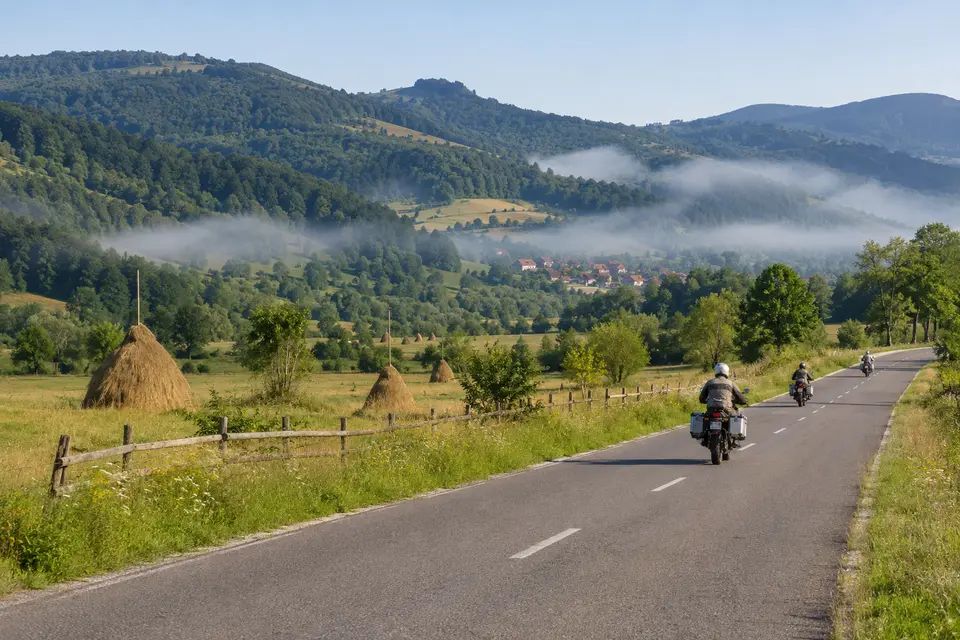 | Romania to Istanbul Adventure | 16 | Bucharest | Adriatic Moto Tours | $8,365 |
 | Best of Sibiu | 8 | Sibiu | Ride Xpower | $2,073 |
 | Long Enduro Tour | 8 | Sibiu | Transilvania Enduro Tours | $1,481 |
 | Long Romaniacs enduro tour | 8 | Sibiu | EnduRomaniaTours | $2,182 |
 | VIP Long enduro tour | 8 | Sibiu | EnduRomaniaTours | $2,051 |
Companies
Every operator here runs its own bikes or its own tours. We list what each operator publishes; we don’t rank them.
- Adriatic Moto ToursBucharest. 1 tour.
- Adventure Motorcycle Tours (Transylvania Live)Cluj-Napoca. 7 bikes. 3 tours.
- AdventurEnduroBucharest. 3 tours.
- AttisWay Moto Rent & ToursBrașov. 5 bikes.
- bike2rentBucharest. 18 bikes from $55 a day.
- EnduRomaniaToursSibiu. 7 tours.
- FM Racing Enduro ToursSibiu. 5 tours.
- Moto TMTimișoara. 6 bikes from $21 a day.
- Moto4RentBucharest. 10 bikes from $83 a day.
- Motorent SibiuSibiu. 2 bikes from $132 a day. 7 tours.
- Ride XpowerSibiu. 4 tours.
- Romania Motorcycle ToursBucharest. 20 bikes. 7 tours.
- Transilvania Enduro ToursSibiu. 3 tours.
- Transilvania Moto RentCluj-Napoca. 8 bikes.








Licence and insurance

You need a licence for the category of bike you ride. The UK government says a UK photocard licence is valid in Romania, and Canada says a Canadian licence can be used for up to six months, though Romanian law (OUG 195/2002, art. 83) asks for an IDP with it; a licence issued in any EU country is valid in Romania as it is. With a licence from anywhere else, carry an International Driving Permit with it (Romania is party to both conventions, so a 1949 or 1968 permit will do) and check your own government's advice. Rental companies often have stricter rules, such as having held the licence for a year.
Every registered vehicle must carry compulsory third-party insurance, called RCA in Romania. It covers harm to others, not damage to the bike you ride. On a rental, damage to the bike usually comes out of your deposit. Canada advises a travel insurance policy that covers your activity; check that yours covers motorcycling at the engine size you will ride.
Helmets are compulsory on motorcycles and mopeds. The alcohol limit is zero, refusing a breath test is illegal, and police can take your licence on the spot. Motorcycle riders must use dipped headlights at all times, on every road. Cars need a rovinietă, a road vignette, outside cities; CNAIR's list of vehicles that need one does not name motorcycles.
When to go

The riding season follows the high passes. The top of the Transfăgărășan, between Bâlea Cascadă and Piscu Negru, is closed every winter for snow and avalanches. It opened on 6 June in 2025 and on 12 June in 2026, and closed from 20 October in 2025. While it is open, traffic on that section is allowed only from 07:00 to 21:00, and it can be shut for a day by storms or rockfall. The high section of the Transalpina, between Rânca and Curpăt, opened on 6 June in 2025 and on 29 May in 2026. In both years it was closed at night: from 20:00 to 09:00 in June, and from 21:00 to 07:00 in July and August. It closes for the winter with the first heavy snow. If you want both roads, come between late June and September.
Winter tyres are compulsory whenever there is snow, ice or sleet on the road, which in practice means from November to March, and that puts most riding out of season.
- Riding months
- Rideable
- Possible, but cold or wet
- Winter: snow, ice, closed
- Average temperature, °C
- Rainfall, mm
Carpathian passes: Sibiu measured at Sibiu
Apuseni: Cluj-Napoca measured at Cluj-Napoca
Bucovina: Botoșani measured at Botoșani
The west and Banat: Arad measured at Arad
The south: Bucharest measured at Bucharest
Read the full guide: When to ride in Romania: the high passes, the seasons and the holidays
Roads, bears and dogs

Main roads are mostly paved and two-lane; the motorway network is still being built. Road conditions vary and potholes are common. In villages expect horse-drawn carts, livestock and stray dogs, and slow lorries to overtake. The Canadian government advises against driving after dark outside the big cities for those reasons.
Romania has one of the largest populations of wild bears in Europe. They forage near mountain towns and roads, Brașov's edges included. If you see one, do not walk up to it. Feeding wild animals is an offence, and on the south side of the Transfăgărășan, where bears wait by the road for food, police and gendarmes fine people both for feeding them and for stopping on the road. Sheep dogs guarding flocks on mountain pastures can be aggressive.
Borders

Romania follows Schengen rules, but the UK government says border guards check passports at the land crossings with Hungary and Bulgaria, and Canada notes that controls can be brought back at short notice. Serbia, Moldova and Ukraine are outside the EU and you go through full border and customs checks. Do not assume a rental bike may leave Romania: ask the shop before you book, and ask what insurance covers outside the EU.
Romania borders Ukraine. Canada reports that drones from the war have crossed into Romanian airspace and debris has landed near the Ukrainian border, and advises care in that area. None of the routes in this guide goes near it.
More guides for Romania
- Renting a motorbike in Romania: where to hire, deposits, insurance and what travel costsHiring a motorbike in Romania: the hubs, licences and deposits, RCA and damage cover, borders and one-way trips, fuel prices and road charges.
Questions riders ask
- When is the Transfăgărășan open?
- Usually from June to October. The high section between Bâlea Cascadă and Piscu Negru opens when the snow is cleared, which was 6 June in 2025 and 12 June in 2026, and closes with the first heavy snow, as early as 20 October in 2025. While it is open you can ride it only from 07:00 to 21:00. Check the CNAIR announcement before you set out, because storms can close it for a day.
- Transfăgărășan or Transalpina?
- Ride both if you can; from Sibiu each is a day. The Transfăgărășan is the tighter road, with a run of hairpins up to Bâlea Lake and a tunnel at 2,042 m. The Transalpina is higher, at 2,145 m, with a ridge section of about 20 km and a 30 km/h limit on the high section.
- Do I need an International Driving Permit to ride in Romania?
- Not with a licence issued in an EU country or a UK photocard licence, and the Canadian government says a Canadian licence is accepted for up to six months, though Romanian law asks for an IDP with it. With a licence from elsewhere, carry an IDP (1949 or 1968) with it, and check your own government's advice. Either way the licence must cover motorcycles.
- How many days do I need for a motorcycle trip in Romania?
- Three or four days from Sibiu or Brașov covers the Transfăgărășan, the Transalpina and a day in the Saxon villages. A week lets you add the Bran road and the Apuseni or Danube routes. The far north, Maramureș and the painted monasteries of Bucovina, needs another three or four days.
- Are there bears in the Romanian mountains?
- Yes. Romania has one of the largest populations of wild bears in Europe, and they come close to towns and roads looking for food, notably on the south side of the Transfăgărășan. Do not walk up to one or feed it: feeding them is an offence, and so is stopping on the road there to watch them.