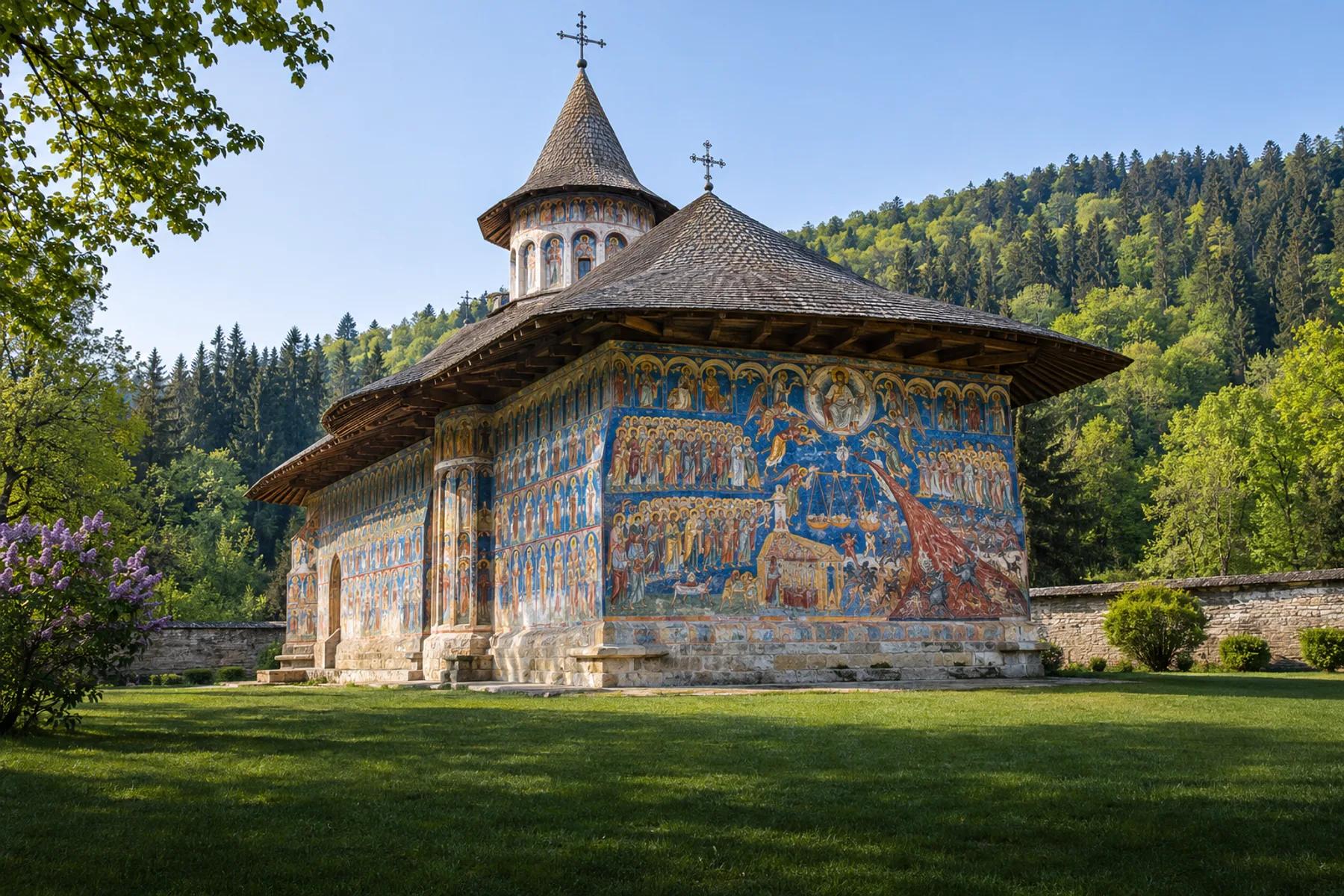
Suceava County
The heart of southern Bukovina in the north-east, with the painted monasteries founded by Stephen the Great and later Moldavian rulers and nobles, the old Moldavian capital at Suceava and the Rarău and Giumalău mountains. The county borders Ukraine to the north.
- County seat
- Suceava
- Area
- 8,553 km²
- Mountains
- Rodna, Rarău and Giumalău
- Rivers
- Siret, Moldova, Suceava, Bistrița
- Time zone
- UTC+2, UTC+3 in summer
What Suceava is known for
- The painted churches of Bukovina
- Churches with frescoes on their outer walls: Voroneț (1488, founded by Stephen the Great), Arbore (1502), Humor (1530), Moldovița (1532, exterior painted 1537) and Sucevița (1581). Voroneț is known for its Last Judgement and the shade called Voroneț blue. The churches form a UNESCO World Heritage Site inscribed in 1993, with Sucevița added in 2010.
- Putna Monastery
- Built by Stephen the Great as thanks for a victory at Kilia, begun in 1466 and consecrated in 1470. He is buried there with his third wife, Maria Voichița, and the tomb is a place of pilgrimage. The Via Transilvanica trail starts at Putna.
- Suceava and its fortress
- Moldavia's capital from 1388 until the seat moved to Iași in 1565. The reconstructed Medieval Seat Fortress stands on the eastern edge of the town, and the Bukovina Museum is one of several museums.
- Rarău and Giumalău
- The mountains above Câmpulung Moldovenesc, a town on the Moldova river. Rarău is 1,650 m and Giumalău 1,857 m.
- Vatra Dornei
- A spa and ski resort at 802 m where the Bistrița and Dorna rivers meet, with a historic casino in the centre and mineral springs. The Dealu Negru slope is 3,200 m long, with a chairlift.
- Cacica salt mine
- A medieval salt mine in Cacica commune with a Roman Catholic chapel of St Barbara inside it.
Things to do
Sorted by how long each takes.
An hour or less
- Suceava Medieval Seat FortressThe reconstructed fortress of the Moldavian princes, on the eastern edge of the town. The Bukovina Museum and other museums are in town.In Suceava
- Cacica salt mineA medieval salt mine with the chapel of St Barbara.In Cacica commune
Half a day
- Voroneț MonasterySt George's church, founded by Stephen the Great in 1488, with the Last Judgement on its outer wall. The monastery is in the Voroneț valley, in the village of Voroneț, now part of Gura Humorului.South of Gura Humorului
- Sucevița MonasteryA fortified monastery in a square courtyard of about 100 by 104 m, with walls about 6 m high and a tower at each corner. Murals cover the inside and outside walls and date from about 1601.In Sucevița commune
- Moldovița MonasteryFounded by Petru Rareș and completed in 1532, with exterior frescoes of 1537 in yellow and blue, among them a procession of saints and the Tree of Jesse.In Vatra Moldoviței
- Putna MonasteryStephen the Great's foundation of 1466 to 1470 on the Putna river, with his tomb inside.In Putna
- Narrow-gauge steam railwayA steam railway network built in Austrian times still runs in Moldovița commune and other rural areas. Ask locally about running days.In Moldovița commune
A full day
- Vatra Dornei and the Dorna depressionA spa and ski town with a historic casino, an ethnographic museum and a museum of natural sciences and hunting.In Vatra Dornei
- Câmpulung Moldovenesc and RarăuA town of the Obcinele Bucovinei hills on the Moldova river, with a museum of wooden spoons. Rarău (1,650 m) and Giumalău (1,857 m) rise nearby.In Câmpulung Moldovenesc
Weather and when to go
- Average temperature, °C
- Rainfall, mm
Suceava long-term average near Suceava
Climate: TerraClimate 1991–2020 monthly climatology (Abatzoglou et al. 2018, Scientific Data 5:170191), public domain (CC0).
The monasteries lie among rolling hills and the mountains are in the south-west and west. Summers in Romania are generally very warm to hot, and in winter the sky is often cloudy and snowfall is common, especially in the mountains around Câmpulung Moldovenesc and Vatra Dornei, a ski resort.
Riding in Suceava
The county's passes include Tihuța, linking Bukovina and Transylvania, Prislop and Ciumârna (Palma). Check conditions locally in winter, because roads in Romania are often not properly ploughed. Canada's travel advice (updated 11 August 2026) says to always be aware of your surroundings, especially near the border with Ukraine.