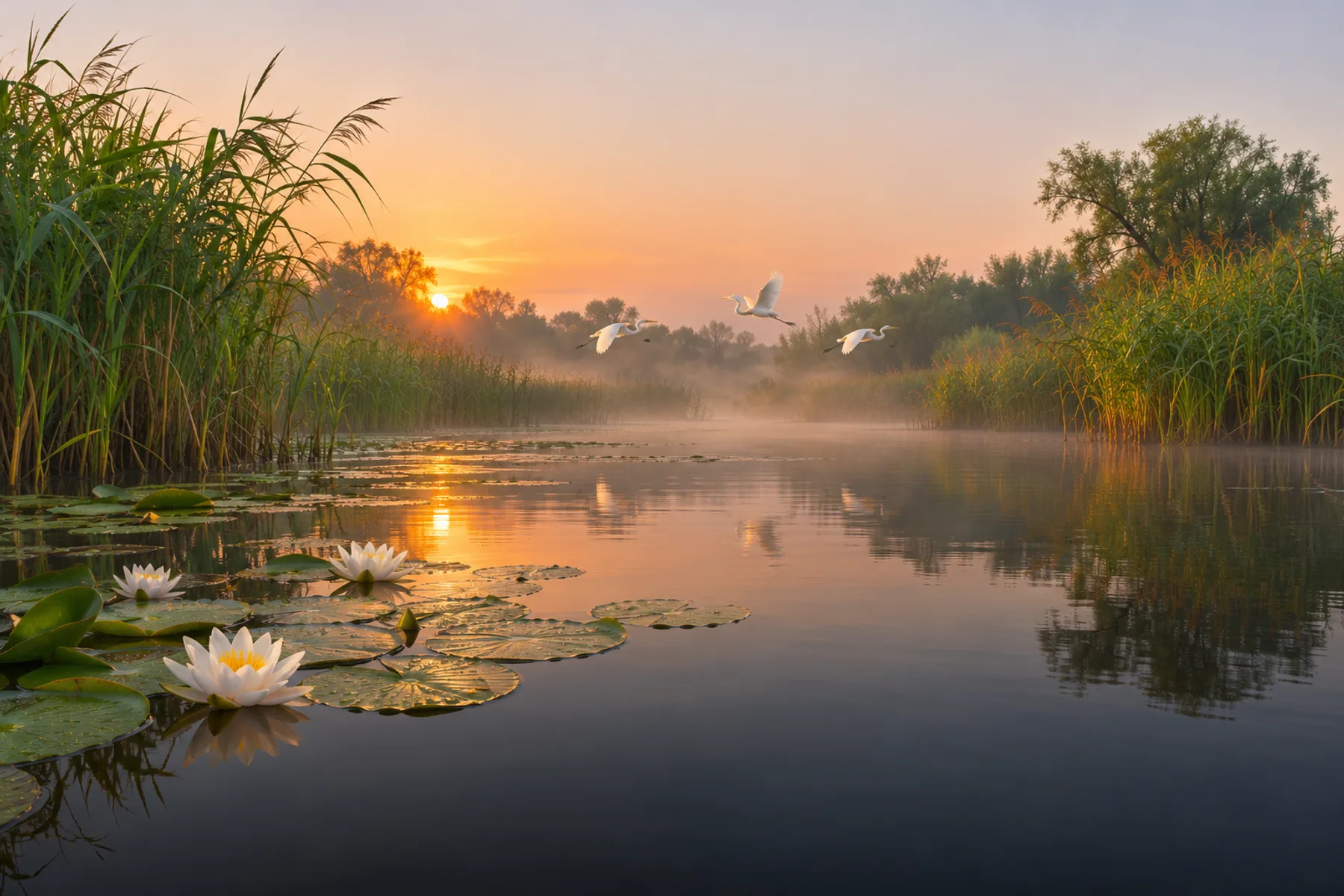
Tulcea County
The Danube Delta takes up about a third of the county in the north-east, with the Măcin Mountains, lagoons and medieval fortresses in the rest. Tulcea town is the base for the delta, and the Danube runs along the west and north of the county.
- County seat
- Tulcea
- Area
- 8,484 km²
- Delta share
- About one third of the county
- Neighbours
- Black Sea, Ukraine, Moldova
- Time zone
- UTC+2, UTC+3 in summer
What Tulcea is known for
- The Danube Delta
- The Romanian part of the delta was listed by UNESCO as a World Heritage Site in 1991. The river splits into the Chilia (120 km), Sulina (64 km) and Sfântu Gheorghe (70 km) branches. More than 320 bird species are found in summer, and over a million birds winter there.
- Tulcea
- The county seat. The Independence Monument stands on a hill with the ruins of the Roman fortress of Aegyssus and a history museum, with views over the Danube.
- Sulina
- A town and free port at the mouth of the Sulina branch, the easternmost point of Romania. Sights include the Lighthouse of the European Commission of the Danube, the Danube Commission palace and its cemetery. It had 3,118 inhabitants in 2021.
- Letea Forest
- A forest of oak groves among sand dunes up to 12.4 m high, between the Sulina and Chilia branches. It has been a nature reserve since 1938 and has half-wild horses, and wild vine, hop and ivy climb its trees.
- Măcin Mountains
- A granite range formed in the Carboniferous and Permian periods, with Balkan and sub-Mediterranean forest and steppe. The highest point, Țuțuiatu, is 467 m. Migratory raptors stop here in autumn.
- Enisala fortress
- A fortress of the late 13th or early 14th century above the lakes Razelm and Babadag, in Sarichioi commune. The Ottomans took it in 1388 or 1389 and again in 1416 or 1417, and it was abandoned around the end of the 15th century.
Things to do
Sorted by how long each takes.
An hour or less
- Tulcea hilltopThe Independence Monument, the ruins of Aegyssus and the history museum share the hill above the Danube. The Tulcea Art Museum and St Nicholas Cathedral are in town.In Tulcea
- BabadagA town on a small lake in the wooded Northern Dobruja highlands, with the Gazi Ali Pasha Mosque and one of the tombs of the dervish Sari Saltik.In Babadag
- Halmyris Roman fortA Roman fort in the county. Ask locally about access.In Tulcea County
Half a day
- Enisala fortressA ruined fortress dominating the lakes of Razelm and Babadag.In Sarichioi commune
A full day
- A boat day in the deltaAsk locally about boat services from Tulcea into the delta. More than 320 bird species are found in the delta in summer.From Tulcea
- Letea ForestOak groves on dunes between the Sulina and Chilia branches, with climbing vines and half-wild horses.In the delta, between two branches
- Măcin MountainsGranite hills rising to 467 m on the west of the county, beside the Danube. Autumn is the time for migrating raptors.In the west of the county
Overnight and longer
- SulinaThe easternmost town of Romania, at the mouth of the Sulina branch, with a lighthouse and the cemetery of the Danube Commission.At the mouth of the Sulina branch
Weather and when to go
- Average temperature, °C
- Rainfall, mm
Tulcea long-term average near Tulcea
Climate: TerraClimate 1991–2020 monthly climatology (Abatzoglou et al. 2018, Scientific Data 5:170191), public domain (CC0).
In summer more than 320 species are found, and over a million birds winter there. Migratory raptors pass over the Măcin Mountains in autumn. In winter snowfall is common.
Riding in Tulcea
The delta is mostly water, so the main routes run around it, and boats leave from Tulcea (ask locally for current services). The Danube runs along the west and north of the county, and Lakes Razelm and Sinoe lie in the south-east. Canada's travel advice (updated 11 August 2026) says to always be aware of your surroundings, especially near the border with Ukraine.