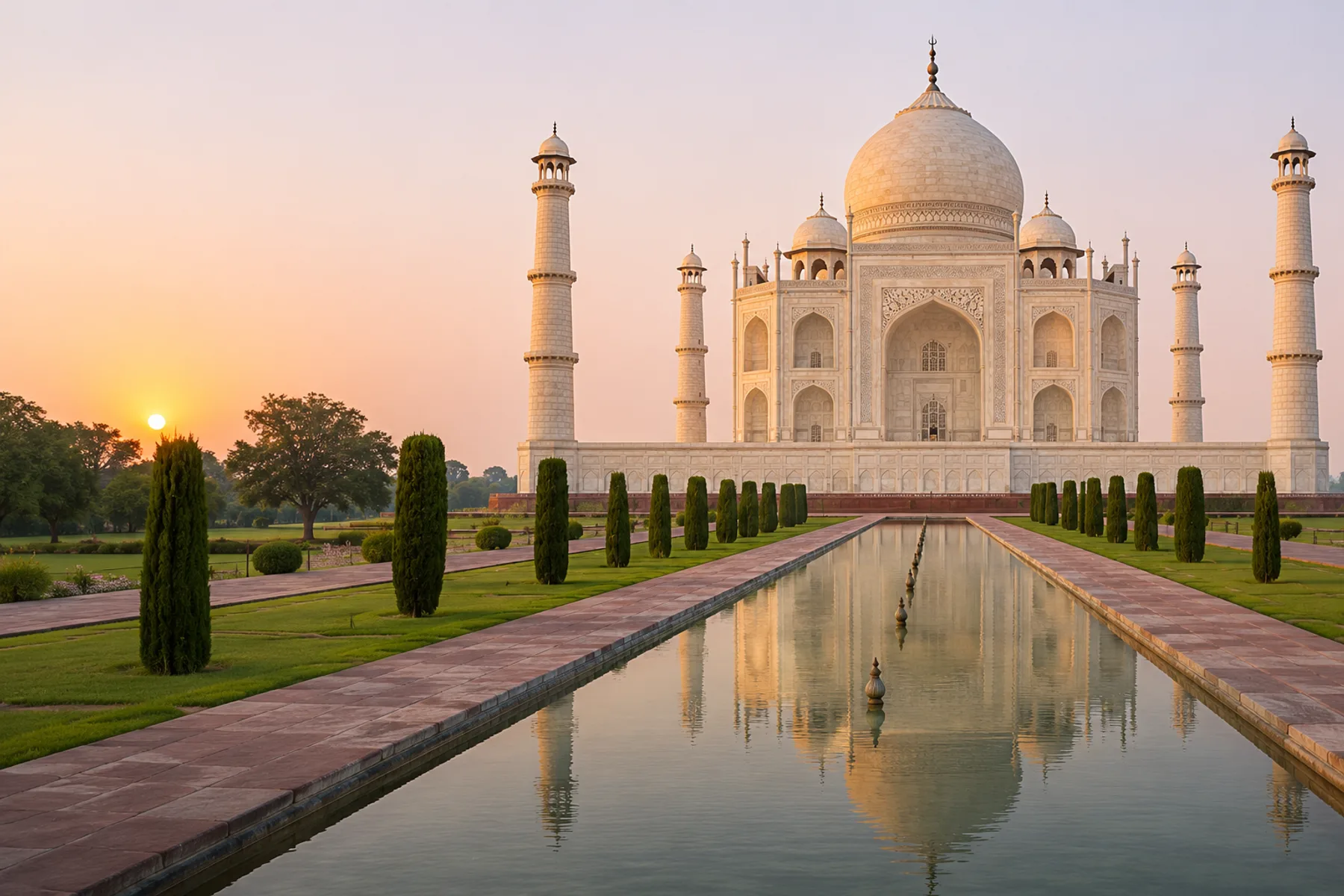
Uttar Pradesh
The Ganges plain: the Taj Mahal, Agra Fort and Fatehpur Sikri, the ghats of Varanasi, Buddhist Sarnath and Kushinagar, and Ayodhya. Lucknow is the capital and the base for the central plain.
- Capital
- Lucknow
- Official languages
- Hindi, with Urdu as an additional language
- UNESCO World Heritage Sites
- Taj Mahal, Agra Fort and Fatehpur Sikri
- Time zone
- UTC+5:30
What Uttar Pradesh is known for
- Taj Mahal, Agra
- An ivory-white marble mausoleum on the right bank of the Yamuna, commissioned in 1631 by Shah Jahan for Mumtaz Mahal and completed in 1648. It is the centrepiece of a 17-hectare complex with a mosque, a guest house and formal gardens.
- Agra Fort
- Rebuilt in red sandstone by Akbar from 1565 to 1573, with white marble palaces and mosques added by Shah Jahan after 1628. It was the main residence of the Mughal rulers until 1638.
- Fatehpur Sikri
- A town in Agra district founded in 1571 by Akbar as the Mughal capital, which he used until 1585. It is a World Heritage Site.
- Varanasi
- A city on the left bank of the Ganges, one of the seven sacred cities of Hinduism and Jainism, known for the ghats, the steps leading down to the river.
- Sarnath
- The town northeast of Varanasi where the Buddha gave his first sermon after his enlightenment. The Lion Capital of Ashoka, raised there in 250 BCE, is the State Emblem of India.
- Ayodhya
- A city on the banks of the Saryu river and one of the seven most important pilgrimage sites, regarded as the birthplace of Rama. It has a Ram temple, and the city is the seat of Ayodhya district.
Things to do
Sorted by how long each takes.
An hour or less
- Bara Imambara, LucknowAn imambara and mosque complex built by Asaf-ud-Daula, Nawab of Awadh, in 1784, now a monument of national importance.In Lucknow
Half a day
- Taj MahalThe white marble mausoleum and its gardens, with the tombs of Mumtaz Mahal and Shah Jahan.In Agra
- Agra FortA red sandstone fort of semi-circular plan with palaces and mosques of white marble inside.In Agra
- Fatehpur SikriThe abandoned Mughal capital, 35.7 km from Agra, the district headquarters.In Agra district
- SarnathThe Deer Park where the Buddha first taught, with the Ashokan pillar remains and Lion Capital.Northeast of Varanasi
A full day
- Varanasi ghatsThe steps down to the Ganges along the old city, and the old city's lanes of silk weaving and crafts.In Varanasi
- AyodhyaThe city on the Saryu, a pilgrimage centre with a Ram temple, and the seat of Ayodhya district.In Ayodhya district
Overnight and longer
- KushinagarThe Buddhist pilgrimage town where the Buddha is believed to have attained parinirvana.In Kushinagar district
- Dudhwa National ParkA Terai park of marshy grasslands of 490.3 km², part of the Dudhwa Tiger Reserve and home to swamp deer.In Lakhimpur Kheri district
Weather and when to go
- Average temperature, °C
- Rainfall, mm
Lucknow long-term average near Lucknow
Climate: TerraClimate 1991–2020 monthly climatology (Abatzoglou et al. 2018, Scientific Data 5:170191), public domain (CC0).
The state has a humid subtropical climate. Winter runs in January and February, summer from March to May and the monsoon from June to September. Summers are extreme, with hot dry winds called the Loo, and excess monsoon rain can cause floods.
Riding in Uttar Pradesh
The state has 42 national highways totalling 4,942 km, and four-lane roads are being built to link district headquarters. The Agra to Lucknow Expressway is a 302 km controlled-access highway. Ask locally whether motorcycles may use it.