Rajasthan
Forts, palaces and the Thar Desert, for riders who have done Jaipur. FCDO (7 Oct 2026) advises against all travel within 10 km of the India-Pakistan border; Canada (6 Nov 2026) says avoid all travel within 10 km of the Pakistan border.
- Capital
- Jaipur
- Official language
- Hindi, with English as an additional language
- Travel advice
- UK and Canada advise against all travel within 10 km of the Pakistan border
- Time zone
- UTC+5:30
What Rajasthan is known for
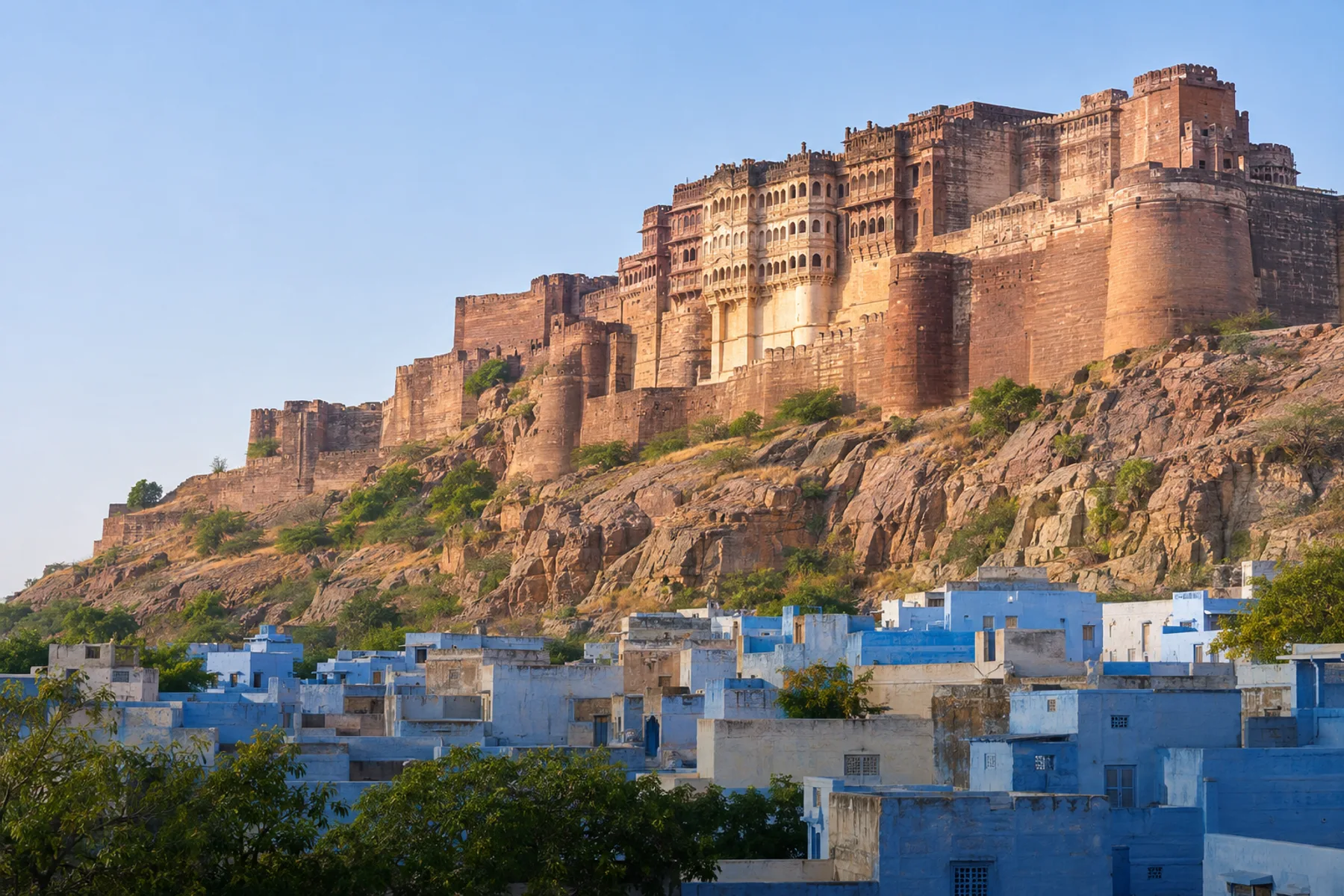
- Mehrangarh, Jodhpur
- A fort on a hilltop rising about 122 m above the plains, first built around 1459 by Rao Jodha, with most of the structure from the 17th century. It has seven gates, palaces with carved courtyards and a museum.
- Jaisalmer Fort
- Built in 1156 by Rawal Jaisal on Trikuta Hill in the Thar Desert, with yellow sandstone walls. Nearly a quarter of the old city's population still lives inside it.
- Udaipur's City Palace and lakes
- The City Palace stands on the east bank of Lake Pichola. The Lake Palace, Jag Mandir, Jagdish Temple and Monsoon Palace are all near it.
- Chittor Fort
- A fort on a 180 m hill above the Berach valley, covering 65 historic structures including four palaces and 19 large temples. It is one of six Hill Forts of Rajasthan listed by UNESCO in 2013.
- Kumbhalgarh
- A 15th-century fort in the Aravalli Hills in Rajsamand district, built by Rana Kumbha. Its wall runs 36 km. It is also one of the six UNESCO Hill Forts of Rajasthan.
- Mount Abu
- A hill station in Sirohi district on a rocky plateau 22 km long and 9 km wide, with Hindu and Jain temples. The Dilwara Temples are five white-marble Jain temples inside one walled compound.
Things to do
Sorted by how long each takes.
Half a day
- Mehrangarh FortSeven gates, including Jai Pol, a museum, and the Chamunda Mataji Temple. Cannonball marks show on the second gate.In Jodhpur
- Jaisalmer Fort and old cityA living fort of honey-coloured sandstone on Trikuta Hill, with shops, houses and temples within the walls.In Jaisalmer
- City Palace, UdaipurA palace complex built over nearly 400 years by Mewar rulers, above Lake Pichola.In Udaipur
- Chittor FortA hilltop fort with palaces, temples and water bodies, once the capital of Mewar.In Chittorgarh
- Ranakpur Jain templeA marble Jain temple dedicated to Adinatha, started in the 15th century, in a valley on the western side of the Aravalli range.In Pali district
A full day
- Kumbhalgarh fort and wallThe fort and its 36 km wall, in the western Aravalli range.In Rajsamand district
- Mount Abu and the Dilwara TemplesA plateau town with five Jain temples carved in white marble, inside forested hills.In Sirohi district
Weather and when to go
- Average temperature, °C
- Rainfall, mm
Jodhpur long-term average near Jodhpur
Climate: TerraClimate 1991–2020 monthly climatology (Abatzoglou et al. 2018, Scientific Data 5:170191), public domain (CC0).
FCDO (updated 7 October 2026) advises against all travel within 10 km of the India-Pakistan border, except for the Wagah-Attari border crossing. The Government of Canada (updated 6 November 2026) says to avoid all travel within 10 km of the Pakistan border. Check the current advice before you go.
Temperatures are extreme from March to October in Jodhpur, hottest from April to June. The south-west monsoon runs from June to September. In Udaipur most visitors arrive between mid-September and late March or early April.
Riding in Rajasthan
The state has 33 national highways. NH 48 is a 4 to 8 lane highway, and Chittorgarh lies on it where NH 76 and NH 79 intersect. Riding area E, the fort and desert loop from Jaipur, covers this ground. The north-west is sandy and dry; a winding road climbs to Mehrangarh.
Riding areas from the India map that pass through Rajasthan:
- Rajasthan forts and desertAbout 1,570 km loop from Jaipur, 8 to 12 days
