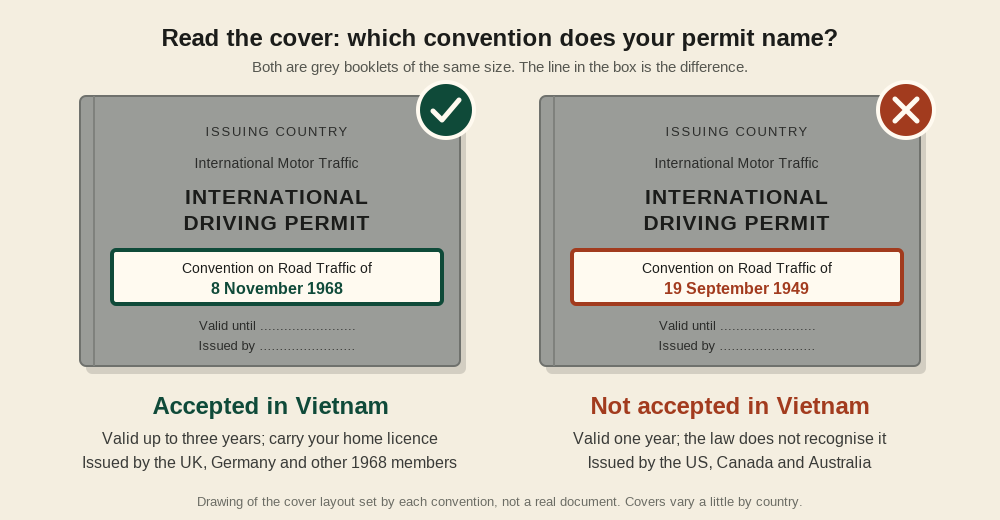
What the law accepts Which countries count? The United Nations treaty list shows Vietnam joining the 1968 convention on 20 August 2014. The United Kingdom and Germany are parties; the United States, Canada and Australia are not, and the permits issued there are the 1949 Geneva kind, which Vietnam's law does not mention. The permit only translates your home licence. It does not add a motorcycle class you do not hold.
Source: United Nations Treaty Collection: Convention on Road Traffic, Vienna 1968, list of parties (Viet Nam acceded 20 August 2014) ; GOV.UK: International driving permits, which IDP each country needs (Vietnam: 1968) ; Law on Road Traffic Order and Safety No. 36/2024/QH15, full text (Nghe An provincial government portal): Articles 9, 33, 56 and 57 ; Wikivoyage: Vietnam by motorcycle (licence, insurance, helmets; revised October 2026)
The two kinds of International Driving Permit. Vietnam's law accepts only the 1968 kind, carried with your home licence. Which permit do I need to ride a motorbike of 50 cc or more in Vietnam?
Your home licence has a motorcycle class and your country issues the 1968 permit (the UK, Germany) Carry the 1968 International Driving Permit and your home licence together. That is legal for a visit. Accepted Your country issues only the 1949 permit (the US, Canada, Australia) Vietnam does not accept it. You need a Vietnamese licence, which Canada and Australia say only residents of at least three months can get. Not accepted Your home licence covers cars only, including Germany's B196 extension It does not cover a motorbike over 50 cc in Vietnam. Ride with a local rider, or travel by car or bus. Not accepted You live in Vietnam on a residence card You may convert your home licence to a Vietnamese one. Ask the provincial transport department where you live. Check Source: Law on Road Traffic Order and Safety No. 36/2024/QH15, full text (Nghe An provincial government portal): Articles 9, 33, 56 and 57 ; United Nations Treaty Collection: Convention on Road Traffic, Vienna 1968, list of parties (Viet Nam acceded 20 August 2014) ; GOV.UK: International driving permits, which IDP each country needs (Vietnam: 1968) ; Government of Canada: Vietnam travel advice and advisories (last updated 19 October 2026) ; Australian Government Smartraveller: Vietnam (updated 24 September 2026, still current at 12 November 2026; read in the Wayback Machine copy of 11 November 2026 UTC) ; Auswärtiges Amt: Vietnam, Reise- und Sicherheitshinweise (Stand 16 November 2026) ; U.S. Department of State: Vietnam international travel information (last updated 17 July 2025; read in the Wayback Machine copy of 19 June 2026) What your own government says What happens on the road Riders report
Wikivoyage's article on the Ha Giang Loop says police set up checkpoints along the loop, at Ha Giang, Dong Van and Meo Vac among others, to enforce the licence rules. Its motorcycling guide says many visitors ride without a proper licence, and that in most places tourists go a bike is easy to rent. After a young British visitor died on the loop in April 2026, Viet Nam News reported that police in Tuyen Quang, the province that now includes Ha Giang, stepped up patrols from 12 April and handled more than 40 violations by tour drivers and self-riding tourists in a few days, and that around 50 rental and travel businesses in Ha Giang were made to sign commitments not to rent vehicles to riders who are not qualified to ride them.
Reported by: Wikivoyage: Ha Giang Loop (police checkpoints, riding with a local rider; revised November 2026) ; Wikivoyage: Vietnam by motorcycle (licence, insurance, helmets; revised October 2026) ; Viet Nam News, 17 April 2026: Ha Giang Loop to see stricter measures rolled out to ensure safety ; Tuoi Tre News, 16 April 2026: Vietnam tightens safety rules on Ha Giang Loop motorbike tours · 2025–2026
The rule
Decree 168/2024/ND-CP sets the fines. Riding a motorcycle up to 125 cc without a valid licence, on one for the wrong class, or on a 1968 permit without the home licence costs 2 to 4 million dong (Article 18(5)); over 125 cc the same offences cost 6 to 8 million (Article 18(7)). Decree 238/2026 amended Decree 168 from 15 August 2026; the official summary we read lists no change to these fines. Article 9(7) of the road traffic law bans handing a vehicle to someone not qualified to ride it, so the shop is breaking the law too. The larger consequences are in your own government's advice: the US says an unlicensed rider can be held criminally liable for injuries or deaths and held in custody during the investigation; Germany says riding without a valid licence can mean a fine or, after a serious accident, several years in prison; Australia says your insurer will likely deny any claim if you are unlicensed or hold the wrong class.
Source: Decree 168/2024/ND-CP on road traffic penalties, full text (Thanh Hoa provincial government file store): Articles 7 and 18 ; Ha Tinh provincial government portal: Decree 238/2026/ND-CP amends Decree 168/2024 from 15 August 2026 (summary of the changes) ; Law on Road Traffic Order and Safety No. 36/2024/QH15, full text (Nghe An provincial government portal): Articles 9, 33, 56 and 57 ; U.S. Department of State: Vietnam international travel information (last updated 17 July 2025; read in the Wayback Machine copy of 19 June 2026) ; Auswärtiges Amt: Vietnam, Reise- und Sicherheitshinweise (Stand 16 November 2026) ; Australian Government Smartraveller: Vietnam (updated 24 September 2026, still current at 12 November 2026; read in the Wayback Machine copy of 11 November 2026 UTC) · checked 16 Nov 2026
Our view
The fine is the small risk. The real one is a crash on a mountain road, a long way from a good hospital, with an insurer that will not pay and a police case that can stop you leaving the country. If your licence does not qualify, do not ride the bike yourself. Ride on the back with a local rider, which on the Ha Giang Loop is what most visitors do anyway, or travel by car and driver, and save the riding for a country that accepts your licence. If you hold a qualifying licence, carry it; it is the cheapest piece of safety equipment you own.
Insurance The rule
Every motor vehicle on the road must carry compulsory civil liability (third-party) insurance, and Article 56(1) of the road traffic law requires the rider to carry the certificate along with the registration certificate and licence. The UK government states plainly that it is illegal to drive without third-party insurance. Under Decree 67/2023/ND-CP the insurer pays at most 150 million dong per person per accident for death or injury caused by the vehicle, and at most 50 million dong per accident for property damage caused by a motorbike. Decree 220/2026, in force since 1 July 2026, amended Decree 67 mainly for construction insurance; the official list of amended articles does not include these limits. The cover is for the people you hurt and what you damage, not your own injuries or the bike.
Source: Law on Road Traffic Order and Safety No. 36/2024/QH15, full text (Nghe An provincial government portal): Articles 9, 33, 56 and 57 ; UK Foreign, Commonwealth & Development Office: Vietnam travel advice, safety and security (still current at 16 November 2026) ; Nghe An provincial government portal: new rules on compulsory civil liability insurance for vehicle owners (Decree 67/2023/ND-CP) ; Dong Nai Department of Construction: Decree 220/2026/ND-CP amends Decree 67/2023 from 1 July 2026 (list of amended articles) · checked 16 Nov 2026
Riders report
Wikivoyage's motorcycling guide says most travel policies cover riding if you hold a valid home motorcycle licence and an International Driving Permit, and most do not without them, and that an insurer will not pay for treatment, evacuation or repatriation after an injury suffered while riding illegally.
Reported by: Wikivoyage: Vietnam by motorcycle (licence, insurance, helmets; revised October 2026)
Our view
Treat the bike's third-party certificate as the legal minimum and nothing more; its limits are low next to the cost of a serious injury. Buy travel insurance that names motorcycling, then ask the insurer in writing whether it covers you on the licence you hold, in Vietnam, on the size of bike you mean to rent. Keep the answer with your policy.
Helmets and alcohol The rule
Article 33(2) of the road traffic law requires the rider and any passenger on a motorbike to wear a helmet that meets the national technical standard, with the strap correctly fastened; the fine for not doing so is 400,000 to 600,000 dong (Decree 168, Article 7). Article 9(2) bans riding with any alcohol in the blood or breath. For a motorbike the fines run from 2 to 3 million dong below 50 mg per 100 ml of blood, 6 to 8 million from 50 to 80 mg, and 8 to 10 million above that or for refusing a test. Germany reminds travellers the limit is zero for every road user, cyclists included; the US warns that riding drunk and causing a fatal accident can lead to immediate imprisonment.
Source: Law on Road Traffic Order and Safety No. 36/2024/QH15, full text (Nghe An provincial government portal): Articles 9, 33, 56 and 57 ; Decree 168/2024/ND-CP on road traffic penalties, full text (Thanh Hoa provincial government file store): Articles 7 and 18 ; Auswärtiges Amt: Vietnam, Reise- und Sicherheitshinweise (Stand 16 November 2026) ; U.S. Department of State: Vietnam international travel information (last updated 17 July 2025; read in the Wayback Machine copy of 19 June 2026) · checked 16 Nov 2026
If something goes wrong Our view
Ride as if a crash will be your fault, because in practice it may be treated that way. Keep your speed down, do not ride after dark in the mountains, and keep your documents on you rather than at the shop. If you are reading this and your licence does not qualify, the honest advice is the same as above: let someone licensed do the riding.