
Riding Uzbekistan
Uzbekistan essentials
- Languages
- Uzbek; Russian widely spoken
- Currency
- Uzbek som (UZS)1 USD ≈ 11,961 UZS on 24 Nov 2026
- Time zone
- UTC+5
- Plugs and power
- 220 V, 50 Hz
Type C Type F - Tipping
- Restaurants
- A 10–15% service charge is often on the bill; otherwise round up
- Hotels
- Small tips for porters
- Tours and guides
- Around US$5–10 a day for a guide or driver
Riders start in Tashkent and most head west on the Silk Road: Samarkand, Bukhara and Khiva, about 1,050 km of flat, paved road that ends across the Kyzylkum desert. For mountains, go east over the 2,268 m Kamchik pass into the Fergana Valley. The quiet option is the Nuratau range and the yurt camps by Aydarkul lake, between Bukhara and Jizzakh.
Ride Concierge
Your ride in Uzbekistan, arranged.
Tell us what you want. We find the bike or tour, write to the operator and come back with a confirmed booking.
- You describe the rideBike, dates, budget. A sentence is enough.
- We ask the operatorAnd bring their quote back to you.
- You approve, we confirmYou pay the operator directly.
Free to ask. Our 5% fee is due only after a confirmed booking.
See how it works- When to ride
- April–May and September–October; June to August is very hot
- Traffic
- Drives on the right; police check documents often
- Licence
- Home licence plus an International Driving Permit
- Registration
- Register within 3 days of arriving; hotels do it for you
- Helmet
- Compulsory for rider and passenger
- Day rate
- $70
- In the catalog
- 3 bikes and tours, 1 operator
Where to ride
Each letter matches the map.

Illustration The Silk Road: Tashkent to Khiva
The ride most visitors come for. The M39 runs south-west from Tashkent through Jizzakh to Samarkand, about 290 km, cutting across a corner of Kazakhstan. Travellers report it is treated as no man's land, with no border check; keep your passport handy anyway. From Samarkand it is about 300 km to Bukhara, then about 460 km across the Kyzylkum to Khiva. All three old cities are UNESCO World Heritage Sites: the Registan in Samarkand, the old centre of Bukhara with its 45.6 m Kalyan minaret, and the walled Itchan Kala in Khiva. Petrol stations are few outside the cities, so fill up whenever you can.
Start from Tashkent

Illustration Chimgan and Charvak
The weekend ride from Tashkent, into the foothills of the western Tian Shan. You leave north-east through Chirchiq and Gazalkent to Lake Charvak, a reservoir behind a 168 m stone dam on the Chirchiq river, hemmed in by the Ugam, Pskem and Chatkal ranges and lined with beaches and guesthouses. Above it, Chimgan village sits at about 1,600 m under Greater Chimgan (3,309 m) in the Ugam-Chatkal National Park. Chimgan is an all-season resort; Beldersay, close by at about 1,700 m, and Amirsoy, with a gondola 2,193 m long, are the other mountain resorts.
Start from Tashkent

Illustration Kamchik pass and the Fergana Valley
The mountain road east. The A373 Tashkent–Osh highway climbs past Angren into the mountains and over the Kamchik pass at 2,268 m, the road link between Tashkent and the Fergana Valley that avoids Tajikistan. It is busy, carrying 10,000 to 15,000 vehicles a day, and is often closed in winter because of avalanche risk. Beyond it, Kokand was the capital of a khanate from 1740, and 19 rooms of the Khudayar Khan palace survive. Rishtan is known for its blue and green ceramics, and Margilan has made silk since at least the 10th century. Andijan is the last town before the Dostyk crossing to Osh.
Start from Tashkent

Illustration West to Nukus and the Aral Sea
For riders who keep going past Khiva. From Bukhara it is about 460 km across the Kyzylkum to Khiva, a long day of empty desert road. North-east of Urgench, in Karakalpakstan, the ruins of Khorezm's desert cities, Toprak-Kala and the fortress of Ayaz-Kala, are a detour off the road to Nukus. The Savitsky Museum in Nukus holds the world's second-largest collection of Russian avant-garde art. Moynaq, about 200 km further north, was a port on the Aral Sea. It is now about 150 km from the water, and the rusting fishing fleet lies in the sand. Khiva reaches 45°C by August.

Illustration Samarkand to Shahrisabz over the Takhtakaracha pass
The pass ride south of Samarkand. The M39 climbs into the hills on the border of Samarkand and Kashkadarya regions and crosses the Takhtakaracha pass, which closes for a time in heavy snow. On the far side is Shahrisabz, where Timur was born. Its historic centre is a UNESCO World Heritage Site, on the List of World Heritage in Danger since 2016 and kept there in 2026. Of his Ak-Saray summer palace, begun in 1380, only parts of the 65 m gate towers still stand.

Illustration Nuratau mountains and Aydarkul lake
A slower way between Bukhara and Jizzakh, for the road to Samarkand or Tashkent. Nurota was founded by Alexander the Great in 327 BC; the remains of his fortress stand at the south of the town, and the Chashma spring, under a mosque with 40 columns, is a place of pilgrimage. North of the Nuratau range, which runs about 170 km east to west and rises to 2,169 m, yurt camps sit in the Kyzylkum by Aydarkul, a large Soviet-made lake with sandy beaches. Villages on the range, such as Sentob, put guests up in family homestays. The main road along the range is paved, but expect some unpaved stretches to the camps around Yangiqazgan.
Regions of Uzbekistan
Where riders base themselves
Tours in Uzbekistan
Prices are what each operator publishes, per rider.
| Picture | Tour | Days | Starts | Operator | Price |
|---|---|---|---|---|---|
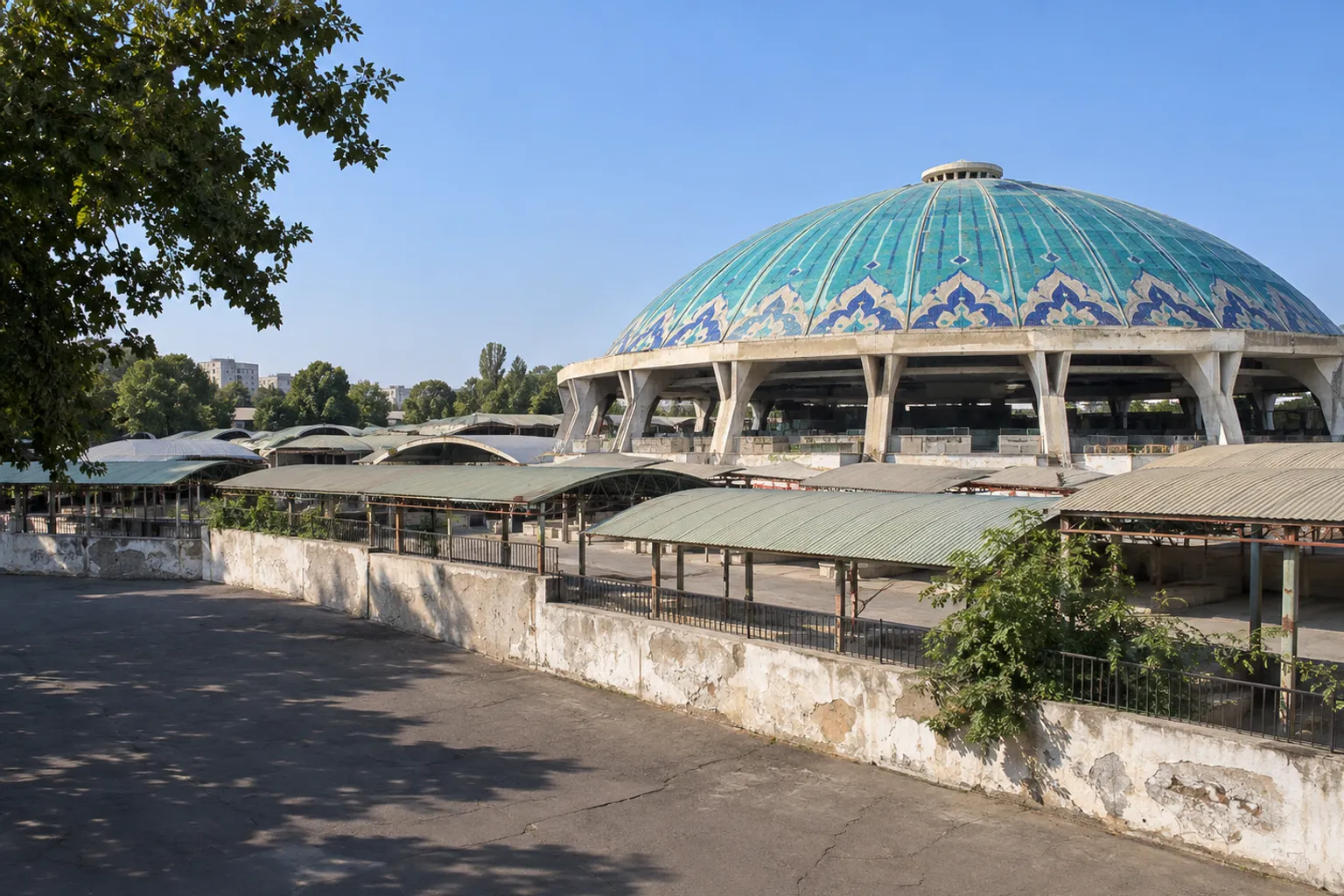
 | Silk Road Odyssey: Historical Journey Through Uzbekistan | 8 | Tashkent | SilkOffRoad Motorcycle Tours | $3,000 |
Companies
Every operator here runs its own bikes or its own tours. We list what each operator publishes; we don’t rank them.
- SilkOffRoad Motorcycle ToursTashkent. 2 bikes from $70 a day. 1 tour.
Licence and insurance

Uzbekistan's traffic rules (point 10 of Cabinet of Ministers resolution 172 of 2022) require a foreign rider to carry a licence that meets the requirements of the Convention on Road Traffic, plus the bike's registration document. Uzbekistan joined the 1968 Vienna Convention in 1995; it is not a party to the 1949 Geneva Convention. The UK government says a UK licence is valid for 30 days, carried with a 1968 IDP. Canada says a Canadian licence alone is not acceptable and you must carry an IDP. Australia says you need your Australian licence and an IDP obtained before you leave. Germany says a German licence is recognised for tourist stays. The US State Department page does not say what US riders need. The US, Canada and Australia are parties to the 1949 convention, not the 1968 one, so their riders should check with the Uzbek embassy, and make sure the motorcycle category is on your licence and permit.
The traffic rules, as reworded in March 2026, require the rider and passengers of a motorcycle, moped or scooter to wear a fastened motorcycle helmet.
Third-party insurance is compulsory for foreign vehicles. Under presidential decree PP-122, from 1 July 2025 customs clears a foreign-registered vehicle only with a liability policy, issued through customs at the border. Check that your travel insurance covers motorcycling.
Read the full guide: Riding legally in Uzbekistan: licences, permits, insurance and helmets
When to go

Spring (April and May) and autumn (September and October) are the riding months. Summer is hot and almost dry: the average July high in Tashkent is about 36°C, Khiva reaches 45°C by August, and the Canadian government notes that rain is very rare in the summer months. One riding directory counts August and September as riding season too, and warns that June and July can be very hot.
Canada gives the rainy season as November to May, with more floods and mudflows in recent years in the Samarkand, Jizzakh, Navoi and Kashkadarya regions, when roads can become impassable. Winters are cold. The Kamchik pass is often closed by avalanche risk, the Takhtakaracha pass closes in heavy snow, and in cold spells the government limits or shuts methane filling stations, which leaves long queues at the propane stations.
- Riding months
- Rideable
- Possible, but poor
- Winter: too cold to tour
- Average temperature, °C
- Rainfall, mm
Tashkent, Chimgan and the east measured at Tashkent
Samarkand, Bukhara, Shahrisabz measured at Samarkand
Khiva, Nukus and the Aral measured at Nukus
The south: Termez measured at Termez
Read the full guide: When to ride in Uzbekistan: spring, autumn and the summer heat
Roads and cities

Roads in Tashkent are generally good. Outside it, rural and mountain roads, especially in the Tian Shan and Fan mountains, have potholes and poor signs, are unlit, and carry livestock and carts without lights. Canada and Germany advise against riding at night. Traffic police stop drivers often for document checks, and the US and Canadian governments report police asking foreigners for bribes. Carry your passport at all times: it is the law, and police check.
Plan your fuel. Outside Tashkent, petrol stations are few and supply is unreliable: Germany says 92-octane is not always available and 95 rarely, and the US warns of difficulty finding petrol outside the capital. AI-80 went off sale in December 2025. Many buses and taxis run on compressed natural gas, and methane stations were repeatedly limited or shut in the winter of 2025–26. Fill up when you can.
You must be registered within 3 days of arriving, and again in each place where you stay more than 3 days. The UK says weekends count in the 3 days; Germany says Sundays and public holidays do not, so do not leave it to the last day. Hotels and private hosts do it for you. If you camp, register yourself online on the Emehmon system and pay the tourist tax; the UK says it takes only an Uzbek bank card. Keep the slips: you can be asked for a full record when you leave, and gaps are fined.
Borders and restricted areas

A foreign bike may stay 90 days in a calendar year without duty (Customs Code, Article 159); after that a daily fee is due. Declare it at the border. Do not assume a rental bike can leave the country; ask first.
Crossings close without notice; Australia says most serve only locals. To Kazakhstan, Zhibek Zholy (Chernyaevka) was last reported closed for renovation (traffic goes via Kaplanbek), and Tejen on the Kungrad–Beyneu road was closed to cars. To Kyrgyzstan, Dostyk (Andijan–Osh) has taken cars since 2019, while Madaniyat–Izboskan is for walkers and cyclists only. To Tajikistan, travellers use Oybek (for Khujand), Panjakent near Samarkand, Denau–Tursunzoda and Gulbahor near Termez. To Turkmenistan: Farap–Alat, Shavat–Dashoguz and Hojayli, with a Turkmen visa arranged first. Check each crossing for vehicles before you go.
The Afghan border along the Amu Darya is fenced and guarded. The UK says the Friendship Bridge at Termez is officially closed to foreigners, Germany says the Termez crossing is closed until further notice, and Canada advises against all travel within 5 km of the border. Australia says do not travel to the Afghan border region, reconsider travel to Andijan and the eastern Fergana Valley, and get a permit for Termez and parts of Surkhandarya. It also reports unmarked landmines near the Afghan, Tajik and Kyrgyz borders: stay on the road.
More guides for Uzbekistan
- Renting a motorbike in Uzbekistan: Tashkent, deposits, insurance and what travel costsWhere to rent in Uzbekistan, what shops ask for, deposits and passports, what the insurance covers, one-way plans, and fuel and registration costs.
Questions riders ask
- Can I ride in Uzbekistan on my home licence?
- Carry your home licence and an International Driving Permit, both covering motorcycles. Uzbekistan's rules ask for a licence that meets the Convention on Road Traffic, and the UK, Canadian and Australian governments all tell their riders to carry an IDP. Germany says a German licence is recognised for tourist stays. Riders from countries that issue the 1949 permit should check with the Uzbek embassy.
- Do I need to register with the police?
- Yes, within 3 days of arriving, and again wherever you stay more than 3 days; do not count on weekends being excluded. Hotels register you automatically, and a private host should do it for you. If you camp, register yourself online through Emehmon and pay the tourist tax, and keep the slips, because you can be asked for a full record when you leave.
- Is petrol hard to find?
- Outside Tashkent, often. Stations are few, the German government says 95-octane is rarely available and 92 not always, and the US warns of difficulty finding petrol outside the capital. AI-80 went off sale in December 2025. Fill up in the cities, and on the long desert legs fill up whenever you see a pump.
- Can I bring my own motorcycle into Uzbekistan?
- Yes. A foreign-registered vehicle may stay 90 days in a calendar year without duty, and a daily fee is due after that. Declare it on entry, carry its registration document, and buy the compulsory Uzbek third-party policy at the customs post, where foreign vehicles are not cleared without one.
- Can I ride to Termez and the Afghan border?
- Be careful. Australia says you need an official permit for Termez and parts of Surkhandarya. Canada advises against all travel within 5 km of the Afghan border, and the UK says the riverbank is fenced and guarded, and that you risk arrest if you approach the fence or photograph military sites. Check with the authorities before you plan the south.