Lumbini Province
The Buddha's birthplace and Nepal's most visited place, with Tilaurakot, Bardia National Park and the Terai highways. Most foreign visitors come from October to March.
- Capital
- Deukhuri
- Districts
- 12
- World Heritage
- Lumbini, inscribed 1997
- Time zone
- UTC+5:45
What Lumbini is known for
- Lumbini
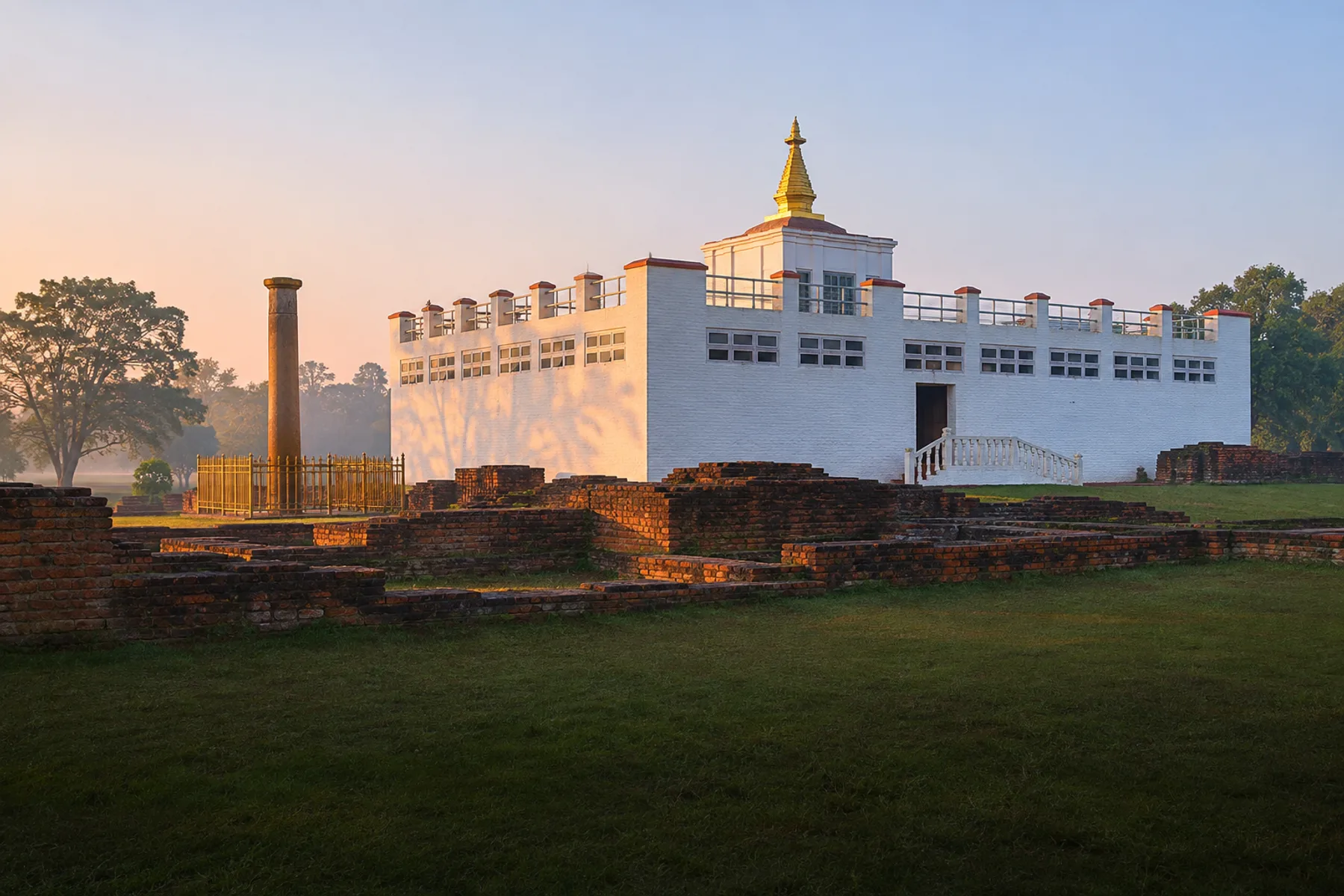
- The traditional birthplace of the Buddha, inscribed on the World Heritage List in 1997. The Maya Devi Temple holds a stone marker, and 2013 excavations found older timber structures beneath its brick walls. An Ashoka pillar was found in 1896. Monasteries from many countries stand in a one-square-mile monastic zone, with a Theravada zone to the east and a Mahayana and Vajrayana zone to the west.
- Tilaurakot
- A site in Kapilvastu district that may be the ancient Shakya city of Kapilavastu. It has a fortified citadel about 500 by 400 m, monumental gateways and a brick stupa, with finds from about 1000 BCE to the 3rd century CE. It has been on the tentative World Heritage list since 1996.
- Bardia National Park
- The largest of the Terai parks, 968 km2, set up in 1988 on the eastern bank of the Karnali River. It holds Bengal tigers, rhinoceros moved from Chitwan from 1986, and gharial. Bardia and Banke together form Nepal's Tiger Conservation Unit.
Things to do
Sorted by how long each takes.
Half a day
- The Lumbini sanctuaryThe Maya Devi Temple and the Ashoka pillar, then the monastic zone, which covers a square mile.In Lumbini
A full day
- TilaurakotThe citadel, gateways and stupa of the ancient town.In Kapilvastu district
Overnight and longer
- Bardia National ParkTiger, rhinoceros and gharial country along the Karnali and Babai rivers.In Bardiya district
Weather and when to go
- Average temperature, °C
- Rainfall, mm
Lumbini long-term average near Lumbini
Climate: TerraClimate 1991–2020 monthly climatology (Abatzoglou et al. 2018, Scientific Data 5:170191), public domain (CC0).
Summer is hot. The monsoon runs June to September with heavy rain, and October is still hot but with cooler nights and lower humidity. Winter is mild by day and cool at night, and colder in the north, where snow is possible. Most foreign visitors come from October to March. April to May and November to December are popular with Indian and Nepali visitors. Canada says many mountain and hill roads are intermittently impassable in the monsoon because of landslides.
Riding in Lumbini
Butwal is where the Mahendra Highway (H01, built in the 1990s) meets the Siddhartha Highway (H10, completed in 1968), which runs from the border at Sunauli through Butwal to Pokhara. Lumbini is about 40 km south-west of Butwal and a 30-minute drive from Bhairahawa. A highway from Nepalgunj to Surkhet runs along part of Bardia's southern boundary. The drive from Kathmandu to Lumbini takes about 10 hours.