Peloponnese
The southern peninsula of mainland Greece, reached from Athens over the Corinth Canal. Mycenae, Epidaurus, Mystras, Monemvasia and the Mani tower villages are the stops.
- Capital
- Tripoli
- Regional units
- Arcadia, Argolis, Corinthia, Laconia, Messenia
- Area of the region
- About 15,490 km²
- Time zone
- UTC+2, UTC+3 in summer
What Peloponnese is known for
- Mycenae
- The Bronze Age citadel in Argolis, 11 km north of Argos. The Lion Gate dates from around 1250 BC, and the Treasury of Atreus is the largest of the nine beehive tombs at Mycenae. UNESCO listed it in 1999 with Tiryns.
- Epidaurus
- The ancient theatre still hosts dramatic performances. It is part of the Sanctuary of Asklepios, listed by UNESCO in 1988, about 8 km from the town of Epidaurus on the Saronic Gulf.
- Mystras
- A fortress-town on a slope of the Taygetos above Sparta, begun by William II of Villehardouin in 1248-49. It has the Palace of the Despots, the only surviving Byzantine palace, and churches and monasteries. UNESCO listed it in 1989.
- Monemvasia
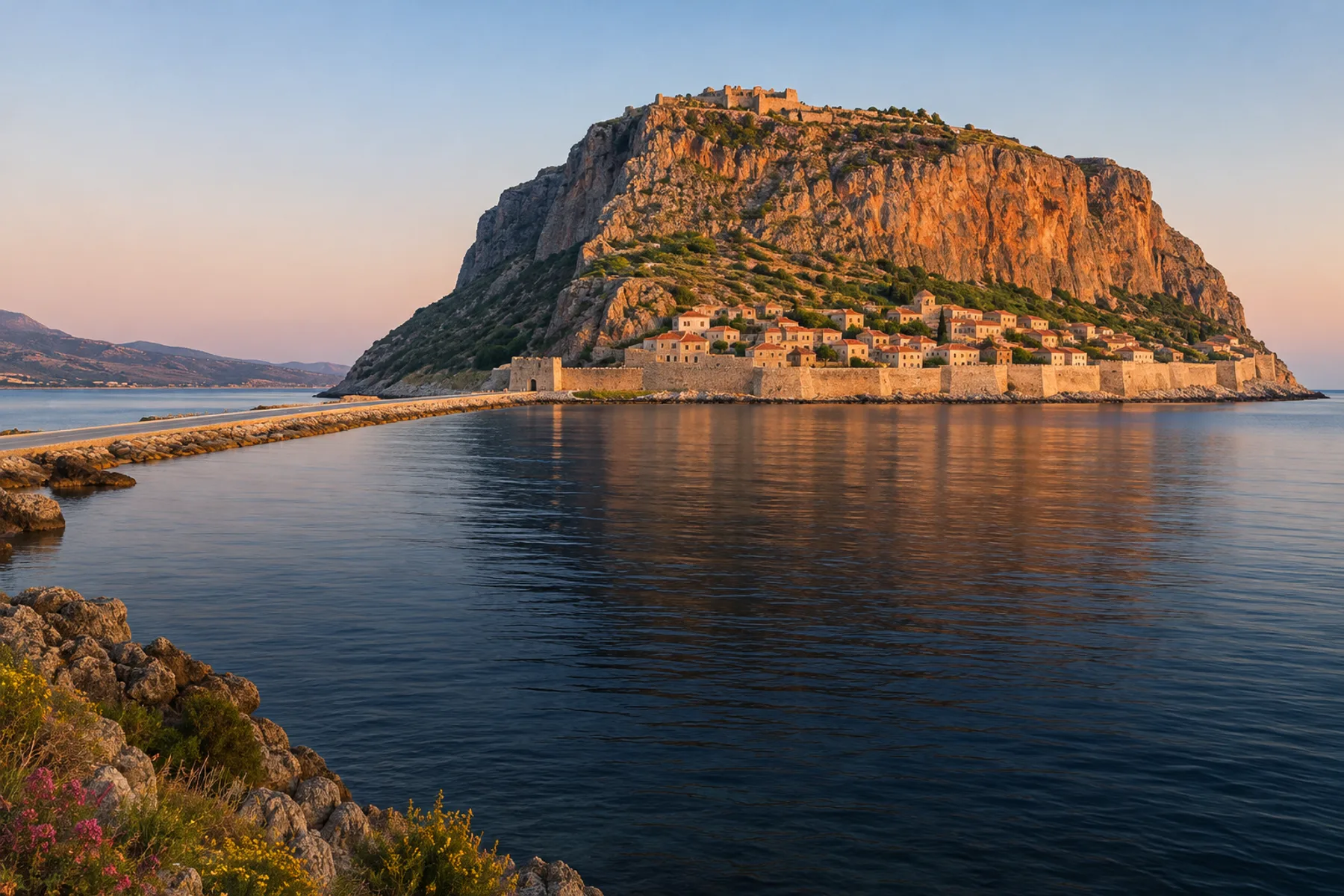
- A town on a rock off the east coast of Laconia, joined to the mainland by a sandy causeway about 400 m long. The rock is a plateau about 100 m above the sea and 1 km long, founded in the 6th century. The lower town is walled on three sides.
- The Mani
- The southern spur of the Taygetus range, known as Many-Towered Maina for its tower houses. Cape Matapan, the ancient Tainaron, is the southernmost point of continental Greece, with the ruins of a temple of Poseidon.
- Corinth Canal
- Completed in 1893 across the Isthmus of Corinth, with bridges that connect the Peloponnese to Attica.
Things to do
Sorted by how long each takes.
Half a day
- MycenaeThe citadel with the Lion Gate and the Treasury of Atreus, in the north-east of the Peloponnese.In Argolis
- Epidaurus theatreThe ancient theatre and the sanctuary of Asklepios in Argolis, on the Argolid Peninsula by the Saronic Gulf.In Argolis
- MystrasWalk the fortress-town up the slope: the Palace of the Despots, Hagia Sophia, St Demetrios, the Peribleptos and the Pantanassa Monastery, where nuns are the only residents.Above Sparta, in Laconia
A full day
- NafplioOn the coast of Argolis, a base for day trips to Epidaurus, Mycenae, Argos, Corinth, Mystras and Sparta.In Argolis
- MonemvasiaCross the causeway to the walled lower town, which has its main entry through the west gate. The bridge on the western side joins the road to the EO86.On the Laconian east coast
- Kalamata to Oitylo coast roadA winding coastal road runs from Kalamata through Kampos, Kardamyli and Stoupa to Oitylo, at the start of the Mani.Kalamata to Oitylo
Overnight and longer
- Inner Mani to Cape MatapanFrom Oitylo the road runs south through Areopoli, Gerolimenas and Vatheia towards Cape Matapan. Inner Mani is known for its tower-house settlements, many now designated traditional.In the Mani
Weather and when to go
- Average temperature, °C
- Rainfall, mm
Tripoli long-term average near Tripoli
Climate: TerraClimate 1991–2020 monthly climatology (Abatzoglou et al. 2018, Scientific Data 5:170191), public domain (CC0).
Summers are hot and winters mild in the eastern, southern and low-lying areas. Rain falls mainly in autumn and winter in the rest of Arcadia, and winter snow is common on the mountains in the west and north, around the Taygetus and Mainalon ranges.
The Canadian government, in advice last updated on 5 October 2026, lists the Peloponnese among the areas where wildfires are common between July and September, and warns that air quality near active fires may deteriorate due to heavy smoke.
Riding in Peloponnese
The Peloponnese loop (area A) runs through the region. The road to Monemvasia is the EO86, and National Road 39 runs north from Gytheio to Sparta. In the Mani a cross-peninsular road runs from Oitylo north-east to Gytheio.
Riding areas from the Greece map that pass through Peloponnese:
- Peloponnese loop950 km, 6 to 8 days