What the law accepts The rule
Section 42 of the Motor Vehicle Act B.E. 2522 says every rider must hold a driving licence and carry it, with a copy of the vehicle's registration book, to show an officer on request. Its second paragraph covers visitors: a foreigner allowed to stay in Thailand temporarily under the immigration law may ride on a licence under section 42 bis, carrying it with the documents named in the conventions or agreements between Thailand and the issuing country. Section 42 bis lets such a visitor use a licence from a country that has a recognition agreement with Thailand, for the types of vehicle the licence shows. Section 4 defines a motorcycle as any motor vehicle on two wheels, a sidecar wheel aside, including a bicycle fitted with an engine. Riding without a licence is punishable under section 64 by up to a month in prison, a fine of up to 1,000 baht, or both.
Source: Motor Vehicle Act B.E. 2522 (1979), consolidated Thai text, Office of the Council of State (hosted by the transport policy office): sections 4, 42, 42 bis, 43, 64
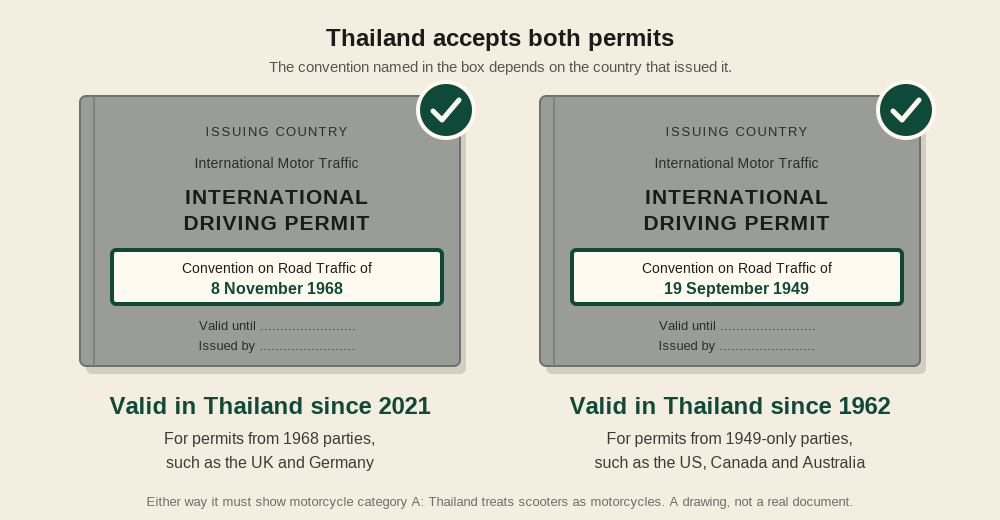
The law does not name a convention; it points to whichever ones Thailand has joined. The United Nations treaty lists show two. Thailand acceded to the Geneva Convention of 1949 on 15 August 1962, and it ratified the Vienna Convention of 1968 on 1 May 2020, declaring that it treats mopeds as motorcycles. That declaration is why a car licence does not cover a scooter: in Thai law and in Thailand's convention commitments, a 110 cc step-through is a motorcycle.
Source: United Nations Treaty Collection: Convention on Road Traffic, Geneva 1949, parties (Thailand acceded 15 August 1962; also the UK, US, Canada and Australia) ; United Nations Treaty Collection: Convention on Road Traffic, Vienna 1968, parties and declarations (Thailand signed 8 November 1968, ratified 1 May 2020; treats mopeds as motorcycles) ; Motor Vehicle Act B.E. 2522 (1979), consolidated Thai text, Office of the Council of State (hosted by the transport policy office): sections 4, 42, 42 bis, 43, 64
Did 1968 change anything? The rule
Under Article 47(2) of the 1968 convention, it took effect for Thailand twelve months after ratification, on 1 May 2021. Article 41 obliges each party to recognise an international permit issued by another party, with the categories on it. Article 48 says the 1968 convention replaces the 1949 one only in relations between countries that are party to both. Thailand has not left the 1949 convention, so it still owes recognition to the 1949 permits of countries that never joined 1968.
Source: Convention on Road Traffic, Vienna 1968, authentic text (UN Treaty Series): Articles 41, 43, 47 and 48 ; United Nations Treaty Collection: Convention on Road Traffic, Vienna 1968, parties and declarations (Thailand signed 8 November 1968, ratified 1 May 2020; treats mopeds as motorcycles) ; United Nations Treaty Collection: Convention on Road Traffic, Geneva 1949, parties (Thailand acceded 15 August 1962; also the UK, US, Canada and Australia) · checked 17 Nov 2026
In practice the answer depends on where your permit comes from. The United Kingdom and Germany are parties to 1968, so between them and Thailand the 1968 permit is the one that counts, and GOV.UK now lists Thailand as a 1968 country. The United States, Canada and Australia are parties to 1949 only, so their 1949 permits remain valid in Thailand. Either way the permit translates your home licence; it adds no class you do not hold. If your home licence has no motorcycle class, no permit will give you one.
Source: United Nations Treaty Collection: Convention on Road Traffic, Vienna 1968, parties and declarations (Thailand signed 8 November 1968, ratified 1 May 2020; treats mopeds as motorcycles) ; United Nations Treaty Collection: Convention on Road Traffic, Geneva 1949, parties (Thailand acceded 15 August 1962; also the UK, US, Canada and Australia) ; GOV.UK: International driving permits, which IDP each country needs (Thailand: 1968) ; Convention on Road Traffic, Vienna 1968, authentic text (UN Treaty Series): Articles 41, 43, 47 and 48
Both kinds of International Driving Permit are valid in Thailand. What matters is the motorcycle category stamped inside. Which permit do I need to ride a motorcycle or scooter in Thailand on a visit?
Your licence is from the UK, Germany or another 1968 party, and shows a motorcycle class Carry the 1968 International Driving Permit, stamped for motorcycles, with your home licence. Accepted Your licence is from the US, Canada, Australia or another 1949-only party, and shows a motorcycle class Carry the 1949 International Driving Permit, stamped for motorcycles, with your home licence. Accepted Your home licence covers cars only Thailand treats every scooter as a motorcycle, so you are not licensed to ride one. Hire a driver, take a motorcycle taxi or ride as a passenger. Not accepted You live in Thailand on a long-stay visa Get a motorcycle licence from the Department of Land Transport. Ask the provincial land transport office where you live. Check Source: Motor Vehicle Act B.E. 2522 (1979), consolidated Thai text, Office of the Council of State (hosted by the transport policy office): sections 4, 42, 42 bis, 43, 64 ; United Nations Treaty Collection: Convention on Road Traffic, Vienna 1968, parties and declarations (Thailand signed 8 November 1968, ratified 1 May 2020; treats mopeds as motorcycles) ; United Nations Treaty Collection: Convention on Road Traffic, Geneva 1949, parties (Thailand acceded 15 August 1962; also the UK, US, Canada and Australia) ; UK Foreign, Commonwealth & Development Office: Thailand travel advice, safety and security (road travel, motorcycle hire; updated 12 October 2026, still current at 17 November 2026) ; Government of Canada: Thailand travel advice and advisories (driving, motorcycles, rentals; last updated 13 October 2026) ; Australian Government Smartraveller: Thailand (driving permits, motorcycles, insurance; updated 26 October 2026, still current at 5 November 2026; read in the Wayback Machine copy of 5 November 2026) ; Auswärtiges Amt: Thailand, Reise- und Sicherheitshinweise, Infrastruktur/Verkehr and Führerschein (Stand 17 November 2026) What your own government says The governments agree in substance. Germany names only the 1968 permit because Germany is a 1968 party; Canada and Australia name no convention, and both are 1949 parties, whose permits Thailand still recognises. The US page is silent on licences, so American riders should go by the law and treaties above. Where a government's wording and the law differ, the law governs.
Source: Auswärtiges Amt: Thailand, Reise- und Sicherheitshinweise, Infrastruktur/Verkehr and Führerschein (Stand 17 November 2026) ; Government of Canada: Thailand travel advice and advisories (driving, motorcycles, rentals; last updated 13 October 2026) ; Australian Government Smartraveller: Thailand (driving permits, motorcycles, insurance; updated 26 October 2026, still current at 5 November 2026; read in the Wayback Machine copy of 5 November 2026) ; U.S. Department of State: Thailand international travel information (road safety, helmets, drink-driving; last updated 2 May 2025; read in the Wayback Machine copy of 9 July 2026) ; United Nations Treaty Collection: Convention on Road Traffic, Geneva 1949, parties (Thailand acceded 15 August 1962; also the UK, US, Canada and Australia)
What happens on the road Our view
A shop that does not ask for your licence has not made you legal. The checkpoint fine is the small risk; the real one is a crash on a mountain road and an insurer that refuses the claim because you were not licensed for the bike. If your licence has no motorcycle class, do not ride: hire a driver, take a motorcycle taxi, or book a tour where someone licensed rides and you sit behind.
Compulsory insurance: Por Ror Bor The rule
Every vehicle registered with the Department of Land Transport, motorcycles included, must carry compulsory motor insurance (Por Ror Bor) under the Motor Vehicle Accident Victims Protection Act B.E. 2535 (1992). It pays only for death, injury or harm to health. The limits below are as two Thai insurers, Chubb Samaggi and Roojai, publish them; we could not open the regulator's own notification, so check the current figures. Without waiting for fault to be settled, the insurer pays preliminary compensation within seven days of a claim: medical costs up to 30,000 baht a person, or 35,000 baht for loss of a limb, permanent disability or death, at most 65,000 baht a person in all. Where the rider of the insured bike is liable, the injured person can claim up to 80,000 baht of medical costs, 200,000 to 500,000 baht for loss of limbs or permanent disability, 500,000 baht for death, and 200 baht a day in hospital for up to 20 days. The rider of the insured bike gets the preliminary compensation only. It covers no damage to any vehicle, and no theft.
Source: Chubb Samaggi Insurance: compulsory motor insurance (Por Ror Bor), preliminary compensation and policy limits ; Roojai Insurance: Compulsory Motor Insurance (Por Ror Bor), legal basis, limits and exclusions · checked 17 Nov 2026
The rule
The governments warn about what that leaves. Germany says motorcycles in particular are sometimes uninsured. Australia says many hire companies have no insurance, that after a crash you could be responsible for damage and for injuries to others, and that you should check the hirer has comprehensive and third-party cover and what excess you would pay. The UK says hire bikes in tourist areas are often unregistered and cannot legally be ridden on a public road. Canada says to check the contract covers damage and theft.
Source: Auswärtiges Amt: Thailand, Reise- und Sicherheitshinweise, Infrastruktur/Verkehr and Führerschein (Stand 17 November 2026) ; Australian Government Smartraveller: Thailand (driving permits, motorcycles, insurance; updated 26 October 2026, still current at 5 November 2026; read in the Wayback Machine copy of 5 November 2026) ; UK Foreign, Commonwealth & Development Office: Thailand travel advice, safety and security (road travel, motorcycle hire; updated 12 October 2026, still current at 17 November 2026) ; Government of Canada: Thailand travel advice and advisories (driving, motorcycles, rentals; last updated 13 October 2026) · checked 17 Nov 2026
The rule
Your travel insurance is your own medical cover, and every government here says to have it. Australia says you may have to pay extra for motorcycling and may not be covered on a vehicle your licence does not cover. The UK says that if you could not legally ride the bike in the UK, your insurer may not cover you in Thailand. Canada, the US and Germany recommend cover for medical evacuation.
Source: Australian Government Smartraveller: Thailand (driving permits, motorcycles, insurance; updated 26 October 2026, still current at 5 November 2026; read in the Wayback Machine copy of 5 November 2026) ; UK Foreign, Commonwealth & Development Office: Thailand travel advice, safety and security (road travel, motorcycle hire; updated 12 October 2026, still current at 17 November 2026) ; Government of Canada: Thailand travel advice and advisories (driving, motorcycles, rentals; last updated 13 October 2026) ; U.S. Department of State: Thailand international travel information (road safety, helmets, drink-driving; last updated 2 May 2025; read in the Wayback Machine copy of 9 July 2026) ; Auswärtiges Amt: Thailand, Reise- und Sicherheitshinweise, Infrastruktur/Verkehr and Führerschein (Stand 17 November 2026) · checked 17 Nov 2026
Our view
Por Ror Bor is the legal minimum and protects other people more than it protects you: as the rider you get the preliminary payment and nothing for the bike. Buy travel insurance that names motorcycling, then ask the insurer in writing whether it covers you in Thailand on the licence you hold and on the engine size you plan to rent. Before you take the keys, ask the shop to show you the bike's registration and its current Por Ror Bor, and what you owe if the bike is damaged or stolen.
Helmets and alcohol The rule
Helmets are compulsory for rider and passenger: Canada and Australia say so, and the UK and Germany that riders must wear one. Canada adds that many helmets on sale do not meet international safety standards, and Australia that hire companies rarely provide them. The Nation reported in May 2025 that police enforce the rule under Section 122 of the Land Traffic Act with a fine of up to 2,000 baht. Under the alcohol-testing regulation published in the Royal Gazette on 20 September 2024, the legal limit is 20 mg of alcohol per 100 ml of blood for riders under 20, holders of a provisional licence, anyone riding without a valid licence or on a licence for a different kind of vehicle, and anyone whose licence is suspended; for other riders it is 50 mg. The US warns that a driver found intoxicated could be jailed for a minimum of two years.
Source: UK Foreign, Commonwealth & Development Office: Thailand travel advice, safety and security (road travel, motorcycle hire; updated 12 October 2026, still current at 17 November 2026) ; Government of Canada: Thailand travel advice and advisories (driving, motorcycles, rentals; last updated 13 October 2026) ; Australian Government Smartraveller: Thailand (driving permits, motorcycles, insurance; updated 26 October 2026, still current at 5 November 2026; read in the Wayback Machine copy of 5 November 2026) ; Auswärtiges Amt: Thailand, Reise- und Sicherheitshinweise, Infrastruktur/Verkehr and Führerschein (Stand 17 November 2026) ; The Nation, 28 May 2025: Royal Thai Police on helmet enforcement under Section 122 of the Land Traffic Act, fine up to 2,000 baht ; Thailand Public Relations Department, September 2024: stricter drunk-driving rules, 20 mg per 100 ml limit for under-20s, provisional licence holders and unlicensed drivers ; Thailand Public Relations Department, September 2024: new alcohol testing regulations in the Royal Gazette (20 mg% groups listed) ; Thairath, 21 September 2024: text of the Ministerial Regulation on testing drivers' alcohol levels B.E. 2567, published in the Royal Gazette on 20 September 2024 (clause 6: limits) ; U.S. Department of State: Thailand international travel information (road safety, helmets, drink-driving; last updated 2 May 2025; read in the Wayback Machine copy of 9 July 2026) · checked 17 Nov 2026
Our view
Bring a helmet you trust or buy a good one in Chiang Mai or Bangkok; the basic shells many shops hand out are not what you want between your head and the road. Do not drink and ride at all.
If something goes wrong The rule
Australia says that after an accident police may detain or arrest you until compensation is agreed, which can cost thousands of dollars, and that the embassy cannot negotiate compensation for you. The US says to contact your insurer for guidance in dealing with the other party and the police. Call 1669 for medical emergencies and rescue, 191 for police, and 1155 for the Tourist Police, where Australia says you can ask for English-speaking officers.
Source: Australian Government Smartraveller: Thailand (driving permits, motorcycles, insurance; updated 26 October 2026, still current at 5 November 2026; read in the Wayback Machine copy of 5 November 2026) ; U.S. Department of State: Thailand international travel information (road safety, helmets, drink-driving; last updated 2 May 2025; read in the Wayback Machine copy of 9 July 2026) · checked 17 Nov 2026
Our view
Keep the speed down, stay off mountain roads after dark, and carry your documents yourself rather than leaving them at the shop. If your licence does not qualify, the honest advice is the same as above: let someone licensed do the riding.