Riding legally in Tajikistan: licences, permits, insurance and helmets
Tajikistan's 2018 Law on Road Traffic accepts foreign licences and international permits that conform to the conventions Tajikistan has joined, and the only one it has joined is the 1968 Vienna convention. This guide sets out what that means by nationality, what the compulsory motor insurance covers, and the helmet and alcohol rules.

What the law accepts
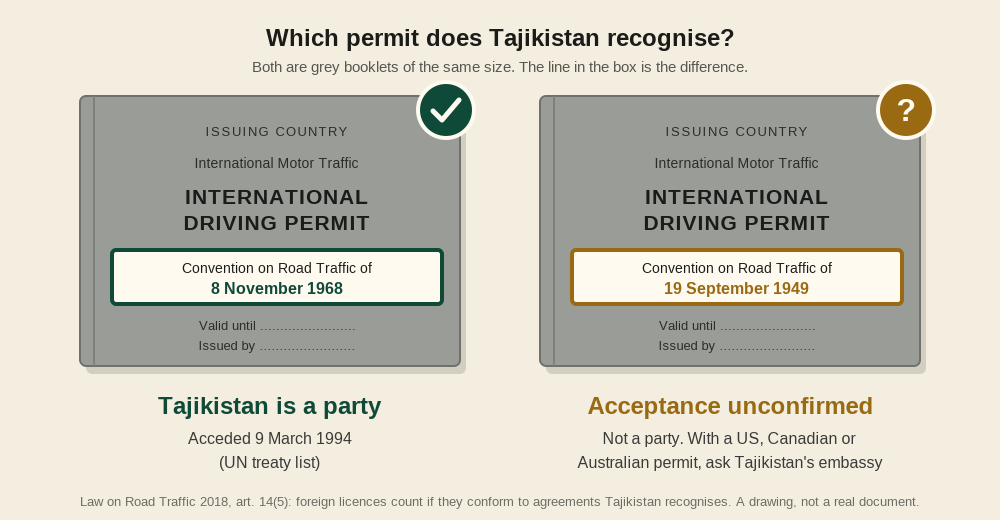
The international act that matters here is the Vienna Convention on Road Traffic of 1968. The United Nations treaty list shows Tajikistan joining it on 9 March 1994. Tajikistan is not a party to the older Geneva convention of 1949. The United Kingdom and Germany belong to the 1968 convention; the United States, Canada and Australia do not, and the permits they issue are the 1949 kind. Whether the law's words cover a 1949 permit from a country outside the 1968 convention is the open question below. Either way, a permit only translates your licence: it does not add a motorcycle category you do not hold.
Source: United Nations Treaty Collection: Convention on Road Traffic, Vienna 1968, list of parties (Tajikistan acceded 9 March 1994); United Nations Treaty Collection: Convention on Road Traffic, Geneva 1949, list of parties (Tajikistan is not listed); State Automobile Inspectorate of Tajikistan (rbda.tj): Law on Road Traffic No 1533 of 17 May 2018, articles 3, 13, 14, 30 and 31 (Wayback copy of 13 April 2026)
Can I ride a motorbike myself in Tajikistan on my licence?
- Your licence has a motorcycle category and comes from a 1968-convention country (the UK, Germany)Yes. Carry it with a 1968 International Driving Permit that also shows the motorcycle category. The UK limits British licence holders to 30 days.Accepted
- Your licence comes from the US, Canada or AustraliaNot confirmed. Your permit is the 1949 kind and Tajikistan never joined that convention. Canada and Australia say licence plus permit will do; ask a Tajik embassy in writing before you ride.Check
- Your licence covers cars onlyNo. Article 13 bars an owner from letting anyone ride a category their licence does not cover. Hire a rider and go as a passenger, or take a car with a driver.Not accepted
- You are moving to Tajikistan to liveArticle 14(6) asks residents to exchange the home licence for a Tajik one. Ask the State Automobile Inspectorate how.Check
What your own government says
| Licence from | Status | What its government says |
|---|---|---|
| United Kingdom | Accepted | You may drive for up to 30 days on a UK licence with the 1968 IDP, which must be bought in the UK before you leave. A Russian or Tajik translation of both is strongly recommended. (UK Foreign, Commonwealth & Development Office: Tajikistan travel advice, safety and security (1968 IDP, 30 days, own vehicle, zero alcohol, ID; updated 19 August 2026)) |
| United States | Check | No official statement found |
| Canada | Check | You must have a valid Canadian licence and an international driving permit. Canada's permit is the 1949 kind, which the law we read does not plainly cover. (Government of Canada: Tajikistan travel advice and advisories (licence and IDP, 0.0% alcohol, police stops; last updated 14 October 2026)) |
| Australia | Check | You need a current Australian licence (a digital one printed and translated into Tajik or Russian) and a valid IDP, got before you leave; driving without it could void your insurance. (Australian Government Smartraveller: Tajikistan (licence and IDP, always wear a helmet, zero alcohol; updated 30 July 2026; Wayback copy of 25 October 2026)) |
| Germany | Accepted | The international driving licence is required and is valid only together with the German national licence. (Auswärtiges Amt: Tadschikistan, Reise- und Sicherheitshinweise (Führerschein, Kontrollpunkte, Versicherung; Stand 17 November 2026)) |
So the five governments do not disagree with each other so much as leave a gap. Britain is the most precise: the 1968 permit, bought at home, and 30 days. That limit is the UK's statement; the law itself names none. Canada and Australia both say a licence and a permit will do, but the permit they issue is one the law does not plainly cover, and the US says nothing. We could not find any statement from the Tajik traffic police or a Tajik embassy that settles the 1949 question.
Source: UK Foreign, Commonwealth & Development Office: Tajikistan travel advice, safety and security (1968 IDP, 30 days, own vehicle, zero alcohol, ID; updated 19 August 2026); State Automobile Inspectorate of Tajikistan (rbda.tj): Law on Road Traffic No 1533 of 17 May 2018, articles 3, 13, 14, 30 and 31 (Wayback copy of 13 April 2026); Government of Canada: Tajikistan travel advice and advisories (licence and IDP, 0.0% alcohol, police stops; last updated 14 October 2026); Australian Government Smartraveller: Tajikistan (licence and IDP, always wear a helmet, zero alcohol; updated 30 July 2026; Wayback copy of 25 October 2026); U.S. Department of State: Tajikistan international travel information (last updated 18 July 2025; read in the Wayback Machine copy of 9 July 2026)
Checkpoints and police stops
Compulsory motor insurance
Asia-Plus reported in December 2020, quoting the National Bank of Tajikistan, that the premium for a motorcycle is one calculation index, which was 60 somoni from 1 January 2021. In March 2026 the Interior Ministry's Dushanbe department began checking insurance with cameras and radar: an owner without a policy gets ten days to fix it, then a fine of 78 somoni. Insurance of this kind pays the people you hurt and the property you damage. It does not pay for the bike you are riding or for your own injuries.
Source: Asia-Plus, 14 December 2020: Tajikistan introduces compulsory vehicle insurance (National Bank of Tajikistan statement; motorcycles one calculation index); Asia-Plus, 2 March 2026: Dushanbe introduces automatic fines for lack of mandatory insurance and vehicle inspection (Interior Ministry's Dushanbe department)
Travel insurance and evacuation
Helmets and alcohol
The earlier traffic rules of 1997, which a commercial legal database shows as repealed in June 2017, required a motorcyclist to wear a fastened helmet and not to carry a passenger without one. We have not seen the 2017 text that replaced them.