What the law accepts The rule
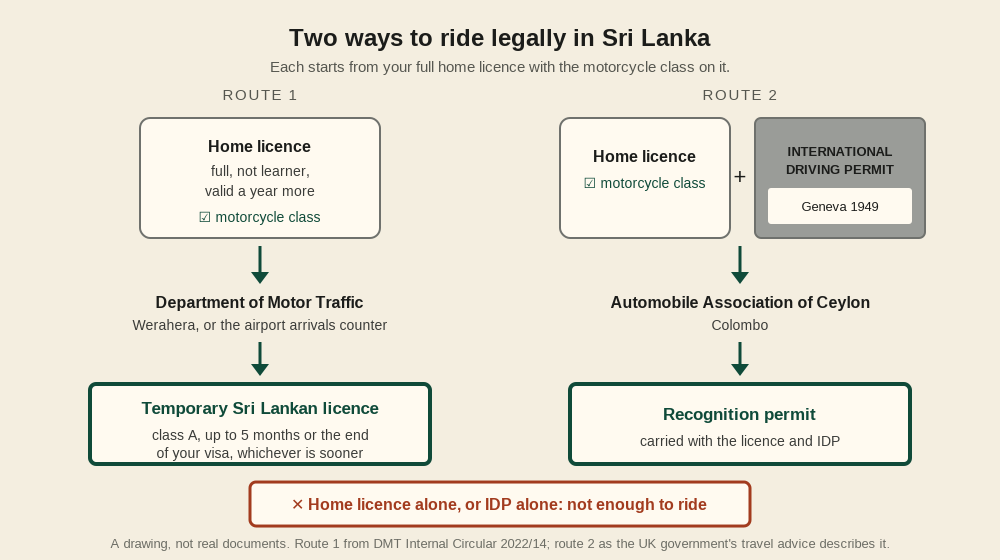
The Department of Motor Traffic issues Sri Lankan licences to foreign licence holders under sections 131 and 132 of the Motor Traffic Act. Its Internal Circular 2022/14 sets the terms. A visitor without a one-year visa gets a temporary licence under section 132, valid for five months or the rest of the visa, whichever is shorter, with the fee charged by the month. The foreign licence must be a full one (not learner, novice, temporary or probationary) and valid for at least a year from the date it is converted. The circular's further condition, a licence from a 1968 Vienna or 1949 Geneva convention country or a SAARC country, is listed for full conversions and is not among those it applies to the temporary licence. Only two classes are issued: A for motorcycles and B for light vehicles. Every restriction on the foreign licence is carried over, and the Commissioner General decides whether to issue at all.
Source: Department of Motor Traffic: Internal Circular 2022/14 (14 November 2022), conversion of foreign licences under sections 131 and 132 of the Motor Traffic Act; temporary licence up to five months
The rule
The second route is an International Driving Permit. Sri Lanka acceded to the 1949 Geneva Convention on Road Traffic in 1957 and is not a party to the 1968 Vienna convention. The UK government says you need a 1949 permit and a Sri Lankan recognition permit to drive a hire vehicle: take your licence, the permit and two passport photos to the Automobile Association of Ceylon, 40 Sir Mohomad Macan Markar Mawatha, Colombo 3, which checks them and issues the recognition permit. Australia describes the same thing as an IDP endorsed by the AA. A permit only translates the licence behind it; it does not add a motorcycle class you do not hold.
Source: United Nations Treaty Collection: Convention on Road Traffic, Geneva 1949, status (Sri Lanka acceded 26 July 1957; not a party to the 1968 Vienna convention) ; UK Foreign, Commonwealth & Development Office: Sri Lanka travel advice, safety and security (1949 IDP and AA Ceylon recognition permit; updated 21 September 2026) ; Australian Government Smartraveller: Sri Lanka, driving permit, motorcycles, insurance (updated 14 August 2026; read in the Wayback Machine copy of 15 November 2026) · checked 17 Nov 2026
The two legal routes for a visiting rider: a temporary licence from the Department of Motor Traffic, or a 1949 permit with the AA Ceylon's recognition permit. Which papers let me ride a motorcycle myself in Sri Lanka?
You hold a full home licence with a motorcycle class, valid for at least another year Get a DMT temporary licence (class A) at the airport counter or in Werahera. It lasts up to five months or until your visa ends. Accepted You hold a 1949 International Driving Permit that covers motorcycles Have it recognised by the Automobile Association of Ceylon in Colombo before you ride, and carry your home licence with it. Accepted You have only your home licence, or only an IDP, and nothing Sri Lankan Not enough. Neither is valid on its own; get one of the two above first. Not accepted Your licence covers cars only, or it is a learner or probationary licence Restrictions carry over and only full licences are converted, so do not expect class A. Ask the DMT before you plan to ride. Check Source: Department of Motor Traffic: Internal Circular 2022/14 (14 November 2022), conversion of foreign licences under sections 131 and 132 of the Motor Traffic Act; temporary licence up to five months ; UK Foreign, Commonwealth & Development Office: Sri Lanka travel advice, safety and security (1949 IDP and AA Ceylon recognition permit; updated 21 September 2026) ; Australian Government Smartraveller: Sri Lanka, driving permit, motorcycles, insurance (updated 14 August 2026; read in the Wayback Machine copy of 15 November 2026) ; Government of Canada: Sri Lanka travel advice and advisories, laws and culture, driving (last updated 2 November 2026) What your own government says None of the five contradicts the circular. The differences are of emphasis: the UK and Australia lead with the permit route, Canada with the DMT, and Germany with a warning. One detail matters for Germans: Germany is not a party to the 1949 convention, so it issues the 1968 permit, while the UK names a 1949 permit for the AA route. The DMT route rests on the licence itself, so it does not depend on which permit your country issues.
Source: United Nations Treaty Collection: Convention on Road Traffic, Geneva 1949, status (Sri Lanka acceded 26 July 1957; not a party to the 1968 Vienna convention) ; UK Foreign, Commonwealth & Development Office: Sri Lanka travel advice, safety and security (1949 IDP and AA Ceylon recognition permit; updated 21 September 2026) ; Department of Motor Traffic: Internal Circular 2022/14 (14 November 2022), conversion of foreign licences under sections 131 and 132 of the Motor Traffic Act; temporary licence up to five months ; Auswärtiges Amt: Sri Lanka, Reise- und Sicherheitshinweise (Stand 17. November 2026): Anmietung von Fahrzeugen, Führerschein, Verkehrsunfälle
Our view
Take the DMT licence at the airport. It needs only the licence you already carry, the counter is in the hall you walk through anyway, and it settles the question for the whole of a normal trip. The AA route means a day in Colombo traffic before your trip has started. Whichever you choose, make sure the paper in your pocket says motorcycle. If your licence covers cars only, Sri Lanka is not the place to start riding: hire a car and driver, or a guide who rides with you on the back.
What happens in practice Insurance, and what happens after a crash The rule
Under the Motor Traffic Act every motor vehicle must be insured. The Insurance Regulatory Commission of Sri Lanka says the minimum the law requires, 'Act only' cover, pays for death and bodily injury to third parties; cover for damage to other people's property is a wider policy, and only fire-and-theft or comprehensive policies pay for damage to the vehicle itself. Germany warns that after a road accident the person said to have caused it is usually held at the police station for at least 24 hours, has their passport taken and is barred from leaving the country, and that the other party usually demands compensation even when the hired vehicle is insured. Leaving normally has to wait until the case is over, which can take months, unless someone stands surety, and Germany warns travellers not to do that for others because the guarantor is barred from leaving too.
Source: Insurance Regulatory Commission of Sri Lanka: Motor insurance (third-party cover compulsory under the Motor Traffic Act) ; Auswärtiges Amt: Sri Lanka, Reise- und Sicherheitshinweise (Stand 17. November 2026): Anmietung von Fahrzeugen, Führerschein, Verkehrsunfälle · checked 17 Nov 2026
The rule
Your own injuries are a matter for travel insurance. The UK says treatment outside the main cities is not readily available, that you may have to be brought to Colombo, and that private treatment and repatriation are expensive. Australia says to ask your insurer whether the policy covers riding a motorbike, and that riding without an IDP or Sri Lankan licence may leave you uncovered by travel or vehicle insurance. Canada says hospitals may want proof of insurance or a deposit before they admit you, and to get cover that includes evacuation. The US recommends supplemental insurance for medical evacuation.
Source: UK Foreign, Commonwealth & Development Office: Sri Lanka travel advice, health (treatment outside main cities, repatriation costs) ; Australian Government Smartraveller: Sri Lanka, driving permit, motorcycles, insurance (updated 14 August 2026; read in the Wayback Machine copy of 15 November 2026) ; Government of Canada: Sri Lanka travel advice and advisories, laws and culture, driving (last updated 2 November 2026) ; U.S. Department of State: Sri Lanka international travel information (last updated 6 May 2025; read in the Wayback Machine copy of 15 October 2025, the live page refused automated access) · checked 17 Nov 2026
Our view
Think of three layers: the bike's compulsory third-party policy, which pays other people; whatever damage cover the rental offers, which you must ask about and get in writing; and your own travel insurance, which must name motorcycling and evacuation and must accept the licence you will hold. Germany's warning is the one to read twice. A crash here can keep you in the country for months, so ride as if every junction could be a court case.
Helmets The rule
Gazette 2287/28, issued on 7 July 2022 under section 158 of the Motor Traffic Act, requires the rider and the pillion on any road to wear a protective helmet, with or without a visor. It must be classed as Type B under the Sri Lanka Standard for protective helmets, or another standard applicable from time to time, and carry the Sri Lanka Standards Institution's certification mark. A visor must not be tinted or coloured or obscure side vision, and the chin strap must be adjustable and fastened securely. The same rules ended the earlier insistence on full-face helmets. Separately, every motorcycle helmet made in or imported into Sri Lanka must carry the SLS 517 mark under Gazette 1923/65 of 2015, and the Consumer Affairs Authority seized hundreds of unmarked helmets in 2026. Australia's advice is simply: always wear a helmet. We could not open the 2022 gazette itself; its wording here is from the Daily Mirror's report of it, so confirm the detail before you rely on it.
Source: Daily Mirror, 16 August 2022: Full face helmet law relaxed; Gazette 2287/28 of 7 July 2022 makes helmets with the SLS mark compulsory for rider and pillion ; Daily Mirror, 31 July 2026: Consumer Affairs Authority crackdown on helmets without the SLS 517 mark (Gazette 1923/65 of 2015) ; Australian Government Smartraveller: Sri Lanka, driving permit, motorcycles, insurance (updated 14 August 2026; read in the Wayback Machine copy of 15 November 2026) · checked 17 Nov 2026
Our view
Wear a helmet that fits, with a clear visor, and check for the SLS mark on whatever the shop hands you. If you want to bring your own, bring one that carries the mark; otherwise try the shop's helmets on before you take the bike and refuse one that is loose, cracked or fogged. A helmet that fits and complies is the only kind worth riding in.
Alcohol The rule
Section 151 of the Motor Traffic Act makes it an offence to drive under the influence of alcohol. The limit set under it is reported as 80 milligrams of alcohol per 100 millilitres of blood, shown by a breath or blood test; the Supreme Court judgment cited here is the usual reference, but we could not open it or the regulations, so treat the figure as unconfirmed. Canada says drinking in public places is prohibited and that alcohol may not be bought on full moon (Poya) days and generally on religious holidays; Australia says the authorities ban the sale of alcohol on Poya days. Australia's advice is: don't drink and drive.
Source: LawNet (Ministry of Justice): Nalinda Kumara v. Officer-in-Charge, Traffic Police, Kandy, Sri Lanka Law Reports 2007 vol. 1 (section 151 of the Motor Traffic Act; 80 mg per 100 ml of blood) ; Government of Canada: Sri Lanka travel advice and advisories, laws and culture, driving (last updated 2 November 2026) ; Australian Government Smartraveller: Sri Lanka, driving permit, motorcycles, insurance (updated 14 August 2026; read in the Wayback Machine copy of 15 November 2026) · checked 17 Nov 2026
Our view
Do not drink and ride, full stop. The legal limit is a number for courts; on Sri Lanka's roads, with buses overtaking blind and dogs asleep on the white line, you need every reflex you have. Have the beer when the bike is parked for the night.