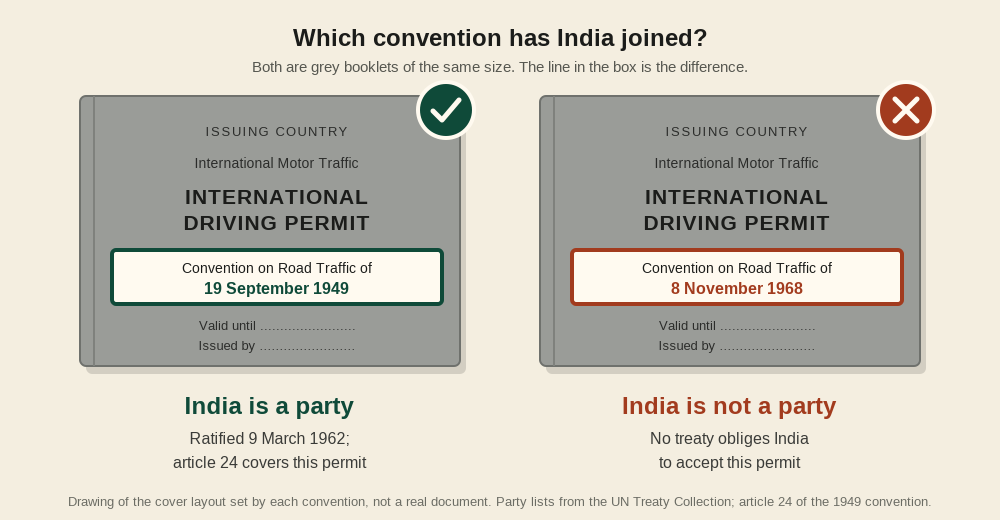
What the law accepts The rule
Section 3(1) of the Motor Vehicles Act says no one may drive a motor vehicle in a public place without an effective driving licence that authorises them to drive that vehicle. Section 181 punishes driving in breach of section 3 or of section 4 (the age limits: 18, or 16 for a motorcycle of up to 50 cc) with up to three months in prison, a fine of 5,000 rupees, or both. Indian licences are issued by class, and section 10(2) separates a motor cycle without gear from a motor cycle with gear. Section 139(1)(c) lets the central government make rules on the conditions under which people entering India for a temporary stay may drive there.
Source: India Code: Motor Vehicles Act, 1988, as amended by Act 32 of 2019, sections 3, 4, 9, 10, 129, 130, 139, 146, 181, 185, 194D, 196 and 210A (Wayback copy of the India Code PDF, 10 November 2022)
The rule
India signed the 1949 Geneva Convention on Road Traffic on 19 September 1949 and ratified it on 9 March 1962; it is not a party to the 1968 Vienna convention. Article 24(1) of the 1949 convention obliges each party to let a visiting driver who holds a valid permit from another party drive, without a further test, the categories of vehicle the permit was issued for, and article 24(2) lets a party require an International Driving Permit on the model in annex 10 as well. Article 1(2) says no party has to extend these rights to a driver who has stayed in its territory for a continuous period of more than a year. The United Kingdom, the United States, Canada and Australia are parties to the 1949 convention. Germany is not on the list.
Source: Convention on Road Traffic, Geneva, 19 September 1949: English text, articles 1 and 24 and annexes 8 to 10 (copy published by Riigi Teataja, the Estonian State Gazette) ; United Nations Treaty Collection: Convention on Road Traffic, Geneva 1949, status (India ratified 9 March 1962; UK 1957, US 1950, Australia 1954, Canada 1965; Germany not listed) ; United Nations Treaty Collection: Convention on Road Traffic, Vienna 1968, status (India not a party) · checked 17 Nov 2026
Put together, the treaty is what lets a visitor ride at all: a licence from a 1949 country, for the category you will ride, with the 1949 permit, for at most a year. A permit only translates the licence; if your licence has no motorcycle class, the permit cannot add one. We could not find the text of the rules India has made under section 139, so we could not confirm a shorter national limit from Indian law itself. That is why the governments' advice below differs, and why the safe limit is the shortest one that applies to you.
Source: India Code: Motor Vehicles Act, 1988, as amended by Act 32 of 2019, sections 3, 4, 9, 10, 129, 130, 139, 146, 181, 185, 194D, 196 and 210A (Wayback copy of the India Code PDF, 10 November 2022) ; Convention on Road Traffic, Geneva, 19 September 1949: English text, articles 1 and 24 and annexes 8 to 10 (copy published by Riigi Teataja, the Estonian State Gazette)
The two kinds of International Driving Permit. India is a party to the 1949 Geneva convention only, so the 1949 permit is the one it is bound to accept. Can I ride a motorcycle myself in India on my licence?
Your licence has a motorcycle class and comes from a 1949-convention country (the UK, the US, Canada, Australia) Yes, as a visitor. Carry the licence with a 1949 International Driving Permit that covers motorcycles, and keep within the shortest limit that applies: three months for Australians, never more than a year. Accepted Your licence comes from a country outside the 1949 convention, such as Germany India is not bound by treaty to accept it. Germany says an international permit is required with the German licence; ask an Indian embassy which permit counts before you plan to ride. Check Your licence covers cars only, or your permit has no motorcycle category No. Section 3 requires a licence for the vehicle you drive, and riding without one is fined 5,000 rupees. Hire a rider and sit on the back, or travel by car with a driver. Not accepted You will stay or live in India for more than a year The convention stops protecting you after a year. Section 9(3) lets an Indian licensing authority waive the driving test for someone who holds a foreign licence for that class; ask the regional transport office. Check Source: India Code: Motor Vehicles Act, 1988, as amended by Act 32 of 2019, sections 3, 4, 9, 10, 129, 130, 139, 146, 181, 185, 194D, 196 and 210A (Wayback copy of the India Code PDF, 10 November 2022) ; Convention on Road Traffic, Geneva, 19 September 1949: English text, articles 1 and 24 and annexes 8 to 10 (copy published by Riigi Teataja, the Estonian State Gazette) ; United Nations Treaty Collection: Convention on Road Traffic, Geneva 1949, status (India ratified 9 March 1962; UK 1957, US 1950, Australia 1954, Canada 1965; Germany not listed) ; Australian Government Smartraveller: India (driving permit, motorcycles, evacuation, satellite devices, alcohol; updated 29 October 2026; read in the Wayback Machine copy of 15 November 2026) ; Auswärtiges Amt: Indien, Reise- und Sicherheitshinweise (Stand 17 November 2026): Führerschein, Trekking und Bergrettung, Satellitentelefone What your own government says Three things stand out. Australia gives a three-month limit where the convention's ceiling is a year and the UK says only that it varies by state; no government gives a source in Indian law for its figure. The US page reads as if the permit alone were enough, but under article 24 the permit stands on the home licence, which the UK, Australia and Germany all tell you to carry. And Germany is outside the 1949 treaty, so a German rider has no treaty right to rely on.
Source: Australian Government Smartraveller: India (driving permit, motorcycles, evacuation, satellite devices, alcohol; updated 29 October 2026; read in the Wayback Machine copy of 15 November 2026) ; UK Foreign, Commonwealth & Development Office: India travel advice, safety and security (IDP, road safety, alcohol, satellite devices, trekking insurance; updated 7 October 2026) ; U.S. Department of State: India international travel information (traffic laws, satellite phones and GPS; last updated 8 May 2025; read in the Wayback Machine copy of 8 August 2025) ; Auswärtiges Amt: Indien, Reise- und Sicherheitshinweise (Stand 17 November 2026): Führerschein, Trekking und Bergrettung, Satellitentelefone ; Convention on Road Traffic, Geneva, 19 September 1949: English text, articles 1 and 24 and annexes 8 to 10 (copy published by Riigi Teataja, the Estonian State Gazette) ; United Nations Treaty Collection: Convention on Road Traffic, Geneva 1949, status (India ratified 9 March 1962; UK 1957, US 1950, Australia 1954, Canada 1965; Germany not listed)
Our view
Get the 1949 permit at home, check that its motorcycle box is stamped, and carry it with the plastic licence, not a phone photo of either. Plan your riding within three months of arrival whatever your passport: that is the shortest limit any of these governments gives, and it costs nothing to stay inside it. German riders should get an answer in writing from an Indian mission before booking a self-ride trip; if the answer is unclear, book a trip with a hired rider or ride pillion.
Insurance The rule
Section 146 of the Motor Vehicles Act forbids using a motor vehicle in a public place, or letting anyone else use it, without a policy of insurance against third-party risks that meets the Act. Under section 196, driving an uninsured vehicle is punished on a first offence with up to three months in prison, a fine of 2,000 rupees, or both, and on a later offence with up to three months or a fine of 4,000 rupees. Section 130(3) obliges the owner or the person in charge to produce the insurance certificate when an officer of the Motor Vehicles Department asks. For hire shops, the Rent a Motor Cycle Scheme makes a licence from the State Transport Authority compulsory and requires the operator to keep at least five motorcycles with permits, comprehensive insurance, fitness certificates and tax paid.
Source: India Code: Motor Vehicles Act, 1988, as amended by Act 32 of 2019, sections 3, 4, 9, 10, 129, 130, 139, 146, 181, 185, 194D, 196 and 210A (Wayback copy of the India Code PDF, 10 November 2022) ; Rent a Motor Cycle Scheme, 1997 (S.O. 375(E), 12 May 1997, made under section 75 of the Motor Vehicles Act), paragraphs 3, 5 and 8 (copy published by the Andhra Pradesh Transport Department) · checked 17 Nov 2026
The rule
Your own medical and rescue cover is travel insurance, and the governments are blunt about why it matters. The UK says to make sure the policy covers altitudes over 2,400 m and mountain rescue and helicopter costs, and that in some border areas only the Indian Air Force can fly rescues, under no obligation and during working hours. Australia says airspace restrictions in places including Ladakh and Jammu and Kashmir may prevent commercial medical evacuation, that the Air Force may be the only option, at costs in the tens of thousands of dollars, and to check that your policy covers motorbike riding. Canada says no commercial mountain rescue operates above 3,000 m. Germany says there is no professional rescue infrastructure for accidents in the high mountains and that help has to be arranged, slowly, through the foreign ministry and the military.
Source: UK Foreign, Commonwealth & Development Office: India travel advice, safety and security (IDP, road safety, alcohol, satellite devices, trekking insurance; updated 7 October 2026) ; Australian Government Smartraveller: India (driving permit, motorcycles, evacuation, satellite devices, alcohol; updated 29 October 2026; read in the Wayback Machine copy of 15 November 2026) ; Government of Canada: India travel advice and advisories (IDP, motorcycles, road safety, satellite and GPS devices, trekking; last updated 6 November 2026) ; Auswärtiges Amt: Indien, Reise- und Sicherheitshinweise (Stand 17 November 2026): Führerschein, Trekking und Bergrettung, Satellitentelefone · checked 17 Nov 2026
Our view
Think in three layers: the bike's third-party policy, which the law requires and the shop should show you; whatever the shop's comprehensive cover pays for damage to the bike, which you should read before you sign; and your own travel insurance for your body. Ask your insurer, in writing, whether it covers you riding a motorcycle in India on your licence, above 5,000 m and with helicopter evacuation. If any of those answers is no, fix it before you fly, not in Leh.
Helmets, alcohol and the papers you carry The rule
Section 129 requires everyone over four years old driving, riding or carried on a motorcycle in a public place to wear a helmet that meets the central government's standard and is securely fastened by its straps; a Sikh wearing a turban is exempt. Section 194D fines a breach 1,000 rupees and disqualifies the rider from holding a licence for three months. Section 185 makes it an offence to ride with more than 30 mg of alcohol per 100 ml of blood, measured by breath analyser or any other test: up to six months in prison, a fine of 10,000 rupees, or both, for a first offence, and up to two years or 15,000 rupees for a second. Section 130(1) obliges a rider to show the licence to any police officer in uniform who asks, and section 210A lets each state multiply these fines by up to ten.
Source: India Code: Motor Vehicles Act, 1988, as amended by Act 32 of 2019, sections 3, 4, 9, 10, 129, 130, 139, 146, 181, 185, 194D, 196 and 210A (Wayback copy of the India Code PDF, 10 November 2022)
The rule
Alcohol law changes at state borders. The UK says the rules on buying and drinking vary by state, that the sale of alcohol is often banned during major religious festivals, national holidays and elections, when police may carry out vehicle checks, and that drinking, making or carrying alcohol is illegal in Bihar, Gujarat, Mizoram, Nagaland and Lakshadweep, with prison sentences of five to ten years. Australia adds that some states forbid bringing alcohol in from another state and that police may check vehicles to enforce it.
Source: UK Foreign, Commonwealth & Development Office: India travel advice, safety and security (IDP, road safety, alcohol, satellite devices, trekking insurance; updated 7 October 2026) ; Australian Government Smartraveller: India (driving permit, motorcycles, evacuation, satellite devices, alcohol; updated 29 October 2026; read in the Wayback Machine copy of 15 November 2026) · checked 17 Nov 2026
Our view
Bring your own helmet; hired ones are often missing or tired, and section 129 puts the duty on you, not the shop. Treat the alcohol limit as zero while the bike is in use, and do not carry a bottle across a state line: in a dry state it is not a fine but a prison sentence.
What happens on the road The rule
The governments agree on what to do after a crash. The UK says to comply with the police if they are at the scene and, if they are not, that it could be unsafe to remain, and to go to the nearest police station if it is safe to do so; accidents involving cows can draw crowds and lead to violence or extortion. Australia says that if you hit a pedestrian or a cow you are at risk of being attacked or extorted, even if you were not riding, and to go straight to the nearest police station.
Source: UK Foreign, Commonwealth & Development Office: India travel advice, safety and security (IDP, road safety, alcohol, satellite devices, trekking insurance; updated 7 October 2026) ; Australian Government Smartraveller: India (driving permit, motorcycles, evacuation, satellite devices, alcohol; updated 29 October 2026; read in the Wayback Machine copy of 15 November 2026) · checked 17 Nov 2026
The rule
Leave satellite devices at home unless India has licensed them. The UK says possessing or using satellite phones and GPS devices without a licence is illegal even in transit, may include handheld or cycling GPS units, and that British nationals have been arrested for it. Australia says this includes personal locator beacons and that the penalty can be up to three years in prison, a fine of up to 20 million rupees, or both; smartphones with maps are legal. Canada says ordinary mobile phones are not included. Licences come from the Department of Telecommunications.
Source: UK Foreign, Commonwealth & Development Office: India travel advice, safety and security (IDP, road safety, alcohol, satellite devices, trekking insurance; updated 7 October 2026) ; Australian Government Smartraveller: India (driving permit, motorcycles, evacuation, satellite devices, alcohol; updated 29 October 2026; read in the Wayback Machine copy of 15 November 2026) ; Government of Canada: India travel advice and advisories (IDP, motorcycles, road safety, satellite and GPS devices, trekking; last updated 6 November 2026) · checked 17 Nov 2026
Our view
The satellite messenger that keeps riders safe in other mountains is the one thing most likely to get you arrested at the airport in this one. Use a phone with offline maps instead, and leave a route plan with your guesthouse.